How to Study for the GMAT in 3 Months
Quick Takeaways
- Commitment: Plan for 10-15 hours/week (consistency is key).
- Month 1 (Foundation): Master core concepts and error logging.
- Month 2 (Strategy): Timed practice sets and weakness targeting.
- Month 3 (Stamina): Full-length mocks and final review.
- Rest: Include buffer days to avoid burnout (marathon, not sprint).
Three months is the sweet spot for GMAT preparation for most working professionals. It's enough time to master the concepts without burning out. This study plan assumes a commitment of 10-15 hours per week—about 1-2 hours on weekdays and longer, focused sessions on weekends. Remember, consistency is your secret weapon.
Why You Need a Strategic Study Plan
The GMAT is not a test you can cram for. It measures higher-order reasoning skills that take time to develop. Without a structured plan, students often fall into the trap of "random acts of studying"—doing a few problems here and there without a clear goal. A plan transforms this anxiety-inducing chaos into a predictable roadmap.
The Anatomy of a High-Scoring Study Plan
Not all study plans are created equal. A generic PDF you found online might not cut it. An effective GMAT study plan must be:
- Specific: It shouldn't just say "Study Quant." It should say "Complete 20 timed inequalities questions and review error log."
- Adaptive: Life is unpredictable. A good plan includes Buffer Days to absorb work emergencies or sick days without derailing your entire schedule.
- Data-Driven: It prioritizes your weak areas based on diagnostic data, rather than treating every topic equally.
- Phased: It shifts focus over time—from learning concepts (Foundation) to applying strategies (Practice) to building stamina (Mock Testing).
Choose Your Timeline
Not sure if 3 months is right for you? Compare our recommended timelines:
| Feature | 1-Month Sprint | 3-Month Standard | 6-Month Marathon |
|---|---|---|---|
| Pace | High Intensity | Balanced | Sustainable |
| Time/Week | 20-30 hours | 10-15 hours | 8-12 hours |
| Best For | Retakers / Full-time | Working Pros | Beginners / Busy jobs |
| Link | Read Guide | You are here | Read Guide |
Your 90-Day Game Plan: An Overview
This 12-week plan follows a phased approach: foundation building (Month 1), strategic application (Month 2), and test readiness (Month 3). The structure assumes 10-15 weekly study hours and includes 4-6 full-length practice tests spaced strategically to measure progress. Each phase has distinct goals—accuracy first, then pacing, then stamina—ensuring you peak on test day without burning out mid-preparation.
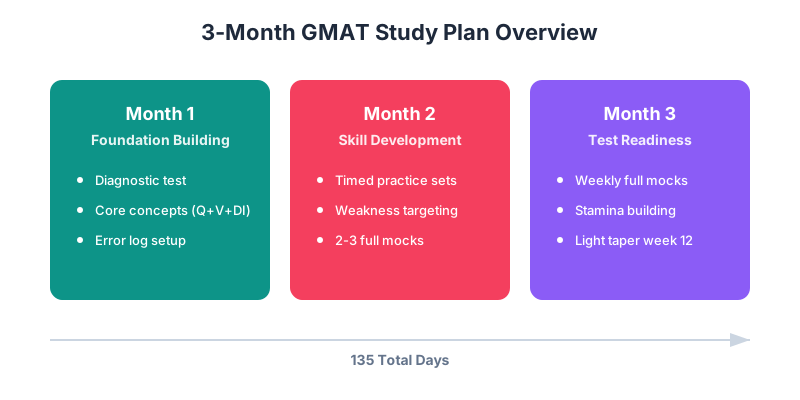
- Month 1: Foundation Building. Start with a diagnostic test, master core concepts (Arithmetic, Algebra, CR Basics), and establish a baseline.
- Month 2: Skill Development & Practice. Shift to timed practice. Focus on error pattern analysis, advanced strategies, and pacing.
- Month 3: Mock Testing & Final Review. Simulate test day with full-length mocks, build stamina, and taper off for peak performance.
This plan includes implied Buffer Days and Rest Days. Life happens—if you miss a study session, use a buffer day to catch up rather than compressing your schedule. OpenPrep's dynamic planner manages this automatically.
Month 1: Building the Foundation (Weeks 1-4)
The first month establishes your baseline score, builds conceptual understanding across all three sections (Quant, Verbal, Data Insights), and creates the error-tracking habits that will guide your entire prep. Focus on accuracy over speed—you'll develop pacing in Month 2. By Week 4, you should complete your second mock test showing measurable improvement in at least one section.
The goal of this month is to understand the test and build a solid conceptual base. Don't worry about speed yet; focus on accuracy.
| Week | Weekly Focus | Key Tasks |
|---|---|---|
| Week 1 | Diagnostics & Quant Foundations | - Weekend: Take your first full-length official GMAT Focus Diagnostic to get a baseline. - Weekdays: Start Quant: Arithmetic, Fractions, Ratios, and Number Properties. |
| Week 2 | Verbal Core & DI Intro | - Weekdays: Verbal Logic: Critical Reasoning (Assumption, Weaken, Strengthen) & RC Structure. - Weekend: Data Insights: Data Sufficiency basics and Table Analysis. |
| Week 3 | Quant Deep Dive & Verbal Strategy | - Weekdays: Advanced Quant: Algebra, Inequalities, Exponents, and Word Problems. - Weekend: Verbal Strategy: Inference, Bold Face, and Method of Reasoning. |
| Week 4 | DI Practice & Foundation Review | - Weekdays: DI Types: Multi-Source Reasoning, Graphics Interpretation, Two-Part Analysis. - Weekend: Take 'Post-Foundation' mock test. Analyze improvement in accuracy. |
Starting an error log in Week 1 is crucial—it becomes your personalized study guide. OpenPrep's built-in error logging automatically categorizes your mistakes by topic and question type, saving you hours of manual tracking and showing exactly which concepts need more practice.
After Week 4's mock test, check your analytics dashboard to see which section improved most and which lagged. This data determines where to allocate extra study hours in Month 2—don't guess, let the numbers guide you.
Month 2: Skill Development & Practice (Weeks 5-8)
Month 2 shifts from learning concepts to applying them under time pressure. You'll tackle 700-level questions, refine pacing strategies, and build your question-pattern recognition. This is when most students see their biggest score jumps—not from learning new material, but from applying what they know more efficiently. Your error log becomes your study bible: recurring mistakes reveal systematic weaknesses that targeted practice can fix.
This is where you build on your foundation. The focus shifts to applying your knowledge, recognizing patterns, and improving your pacing.
| Week | Weekly Focus | Key Tasks |
|---|---|---|
| Week 5 | Targeted Weakness Practice | - All Week: Analyze your Week 4 mock test results. Dedicate this week to drilling your weakest areas with targeted practice sets. |
| Week 6 | Time Management & Pacing | - Weekdays: Do timed practice sets for all sections. Aim to answer questions within the ~2-minute average. - Weekend: Take another full-length mock test under strict, timed conditions. |
| Week 7 | Advanced Quant & Verbal | - Weekdays: Difficult Topics: Statistics, Sets, Probability, Combinations (700-level focus). - Weekend: Complex DI: Multi-Source Reasoning & Two-Part Analysis sets mixed with Quant concepts. |
| Week 8 | Strategy Refinement & Mid-Point Review | - Weekdays: Review your error log from the past month. Identify recurring mistake patterns. - Weekend: Take a mock test. Analyze your performance, especially your time management and decision-making on tough questions. |
Month 3: Mock Testing & Final Review (Weeks 9-12)
The final month prioritizes stamina building and mental preparation. You'll take your final 2-3 mock tests (Weeks 9, 11), simulate full test-day conditions (including breaks), and focus on confidence-building rather than cramming new material. Week 12 is about tapering—light review only, with 2-3 days of complete rest before test day. Students who over-study this final week often perform worse due to mental fatigue.
The final month is about building stamina, cementing your strategies, and getting into the test-day mindset. No new concepts here—just polish and practice.
| Week | Weekly Focus | Key Tasks |
|---|---|---|
| Week 9 | Full Mock & Deep Analysis | - Weekend: Take a full-length mock test. - Weekdays: Spend the entire week on a deep-dive analysis of that test. Review every single question, right or wrong. |
| Week 10 | Final Weakness Blitz | - All Week: This is your last chance to address any lingering weaknesses. Use targeted practice quizzes to drill these specific areas. |
| Week 11 | Final Mock & Stamina | - Weekend: Take your final full-length practice test. This is to simulate the full test experience and build confidence. - Weekdays: Light review of your notes and error log. |
| Week 12 | Final Review & Peak Performance | - Mon-Wed: Light Review: Revisit key formulas and 1-2 high-confidence sets. No new learning. - Thurs-Fri: Tapering: Complete rest, sleep, and mental prep. - Saturday: Test Day! Trust the process. |
Avoid the temptation to cram in Week 12. Your brain needs rest to consolidate learning. Students who study intensely the day before the test often experience mental fatigue and score 20-40 points lower than their practice test averages.