5 Signs Your GMAT Prep Is Working (And How to Track Real Progress)
Most GMAT aspirants track two things obsessively: their speed on practice questions and their average mock score. They build spreadsheets, calculate weekly averages, and feel good on weeks when they finish questions faster or post a higher number.
Then they plateau at 645 and have no idea why.
The problem is that speed and average score are lagging indicators. By the time they reflect a problem in your prep, the problem has been compounding for weeks. The metrics that actually predict a 700+ score are not numbers on a dashboard — they are changes in your behaviour. Behaviours that are often invisible to the student making them.
If your prep is genuinely working, you will start noticing these five shifts. Be honest with yourself as you read through them.
1. Why Most Aspirants Track the Wrong Metrics
There is a reason mock score averages are the most common progress metric: they are easy to see, they feel objective, and they provide a number you can compare against your target. The problem is that a single mock score reflects dozens of variables that have nothing to do with how well you have internalised the underlying logic — the difficulty of the specific question set, whether you slept well, how anxious you were, and simple statistical variance.
Tracking your average mock score is like a basketball player tracking points per game while ignoring shot selection, decision-making under pressure, and situational awareness. The score is a downstream output. The skill is what causes it.
Similarly, tracking speed on practice questions is seductive but misleading. Speed is not a GMAT skill — it is a byproduct of precision. Students who deliberately try to get faster almost always get slower, because rushing increases their rate of backtracking and second-guessing. Speed improves naturally when the underlying logical process becomes automatic — and not before.
2. Sign 1: You Track Root Causes, Not Just Question Types
Most error logs look like this: "I got a rate problem wrong." That is useless information. Every person who gets a rate problem wrong did so for a completely different reason. One student forgot to convert minutes to hours. Another set up the formula correctly but solved for the wrong variable. A third misread the constraint in the question stem. The same question type, three different root causes, three different fixes.
The shift that signals real progress is when your error log starts looking like this: "I set up the equation correctly but calculated the answer in miles per minute, not miles per hour, because I did not check my units before moving to the answer choices." That is a root cause. That is a specific, reproducible mistake you can now test yourself against.
- Tagging question types tells you which subject area to study more. It does not tell you what is actually broken in your thinking.
- Tagging root causes tells you exactly which mental step you are skipping or executing incorrectly — and gives you a specific thing to drill and verify.
On GMAT Quant, the two most common root cause categories are: misreading the constraint in the question stem (what is the question actually asking?), and failing to check what the question is asking for after computing a value.
If your post-question review takes 30 seconds and ends with a question type label, you are doing error logging wrong. A genuine root cause analysis takes 3 to 5 minutes and produces a specific, verifiable mistake — something you can test yourself on deliberately in the next session. OpenPrep automatically tags root cause categories on every wrong answer, so instead of manually building this taxonomy, you can see which mental steps are breaking down most frequently across your full practice history.
3. Sign 2: You Flag Questions You Got Right but Guessed On
This is the most underrated behaviour in all of GMAT prep, and almost no one does it spontaneously.
When you guess on a question and get it right, your error log records nothing. Your review session skips it. Your brain registers it as a win and moves on. But a lucky guess is not a win — it is a future mistake that has not happened yet. You have a gap in your understanding that is now invisible to you, and the next time that concept appears on the exam, the gap will cost you points.
Think about what a lucky guess actually means at the structural level. You did not understand the question. You eliminated two choices and picked between the remaining three by feel. The GMAT adaptive algorithm registered a correct answer and may now serve you a harder version of the same concept — which will expose the gap you never filled.
Every "correct but unsure" question is a future mistake waiting to happen. On test day, luck runs out. Your preparation is not complete until you can solve every question correctly on purpose — not by elimination, not by intuition, and not by a coin flip.
The shift that signals real progress is when you start marking every question where you were not fully confident — even if you got it right — and reviewing those with exactly the same rigour you apply to your wrong answers.
4. Sign 3: You Have Stopped Predicting Critical Reasoning Answers
Every GMAT resource tells you to "pre-think the answer" before looking at the answer choices on Critical Reasoning questions. This advice works for some students. For others, it is a trap.
The danger of pre-thinking is confirmation bias. You form an answer in your head and then your brain selectively reads the answer choices to find the one that matches your prediction. You stop evaluating choices on their own terms. When the correct answer is phrased differently from your mental model, you eliminate it.
The more advanced approach — and the shift that signals genuine CR progress — is aggressive elimination. Instead of asking "which choice matches my prediction?" you ask, for each choice: "Can I find a specific, logical reason this is wrong?"
| Flaw Type | What It Looks Like |
|---|---|
| Scope error | The choice introduces a concept or entity not present in the original argument |
| Direction error | The choice weakens when you need to strengthen, or strengthens when you need to weaken |
| Irrelevance | The choice is factually plausible but logically disconnected from the specific conclusion |
When you can label exactly why four choices are wrong — not just that they feel wrong — you have fundamentally changed how you engage with CR. You are no longer guessing from a prediction; you are eliminating from evidence. That is the shift that separates a 655 CR score from a 715 one.
5. Sign 4: You Have Slowed Down to Go Faster
Speed is not a GMAT skill. It is a byproduct of precision. Most students who are slow on the GMAT are not slow because they cannot move quickly — they are slow because they execute imprecisely. They start solving before fully understanding what is being asked. They choose the wrong approach, work themselves into a dead end, and spend additional time backtracking.
A 3-minute question solved correctly on the first pass is better than a 2-minute question you rushed, second-guessed, and got wrong. Optimise for first-attempt accuracy. The speed will follow.
The paradox that marks real progress: students who deliberately slow down — who spend 15 extra seconds reading the question stem carefully, who pause to confirm their approach before calculating — get faster overall. Because they make fewer false starts. Because they solve on the first attempt instead of the second or third.
6. Sign 5: Your Mock Score Variance Is Shrinking
Everyone looks at their highest mock score. Experienced tutors look at the variance across mocks. A high score on a single mock can be explained by question difficulty, a favourable question set, or a good day. But a series of consistent scores tells you something extremely important: the skill is stable. It will show up on test day regardless of which question set you receive.
| Candidate | Mock Scores | Average | Verdict |
|---|---|---|---|
| Candidate A | 605, 685, 615, 670, 640 | 643 | High variance — performance is context-dependent. Unpredictable on test day. |
| Candidate B | 645, 655, 650, 665, 660 | 655 | Low variance — skill is internalised. This score will show up consistently. |
Candidate B is in a dramatically better position for test day — even though Candidate A has a higher peak score. Candidate A's performance is context-dependent: on a good day they score in the 680s; on a hard day they drop into the 600s. That unpredictability does not go away under test-day pressure — it gets worse.
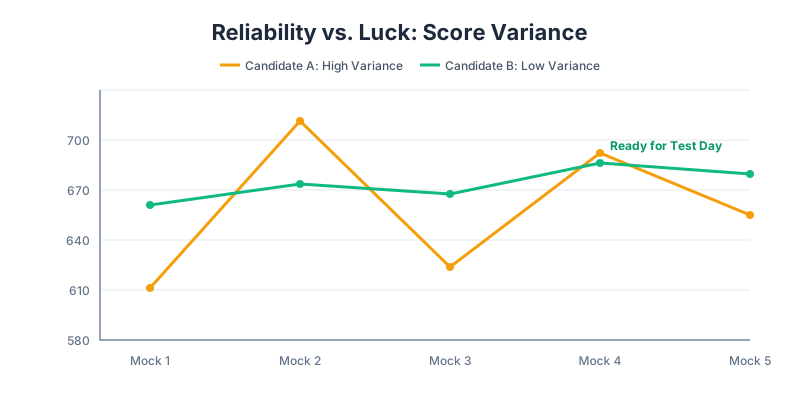
High variance in your mock history usually points to one of two causes: your performance is question-set-dependent, or you have content gaps in specific areas that appear inconsistently across mocks. Both are fixable — but only if you are tracking variance, not just peak scores.
OpenPrep's variance dashboard tracks your score consistency across every practice mock automatically — so instead of manually calculating standard deviation on a spreadsheet, you can see at a glance whether your score band is tightening or still too erratic to trust on test day.
7. The Honest Bottom Line
The difference between a 655 and a 705 is not intelligence. It is not even the number of hours studied. It is how ruthlessly you track and fix your own patterns.
Most aspirants review questions. The top scorers diagnose themselves. They know precisely why they got things wrong. They know which correct answers were actually lucky guesses. And they know whether their progress is real improvement or just noise in the data.
Count how many of the five signs you are genuinely exhibiting. Start the ones you are not. A month of genuine diagnostic review consistently outperforms three months of high-volume drilling without reflection.