GMAT Cold Mock: The Fastest Way to Kickstart Your Prep
When I look at registration data from OpenPrep Academy, one number stands out every single time: over 75% of new students sign up without ever having taken a single practice exam.
That is not a small cohort of procrastinators. That is most people.
They spend their first three weeks doing everything except starting. They buy thick GMAT textbooks. They research prep courses, read forum threads comparing study plans, download massive PDF guides, and build colour-coded Notion schedules. They debate whether to take the official practice test first or the third-party ones. They do all of this to delay the one step that actually launches your prep: taking an initial practice exam.
The fastest, most effective way to begin your GMAT journey is to go to mba.com, load up Official Practice Exam 1, and take it completely cold — today, with no preparation.
This is not conventional wisdom. Most people do the opposite. This article explains exactly why they are wrong, and what you should do instead.
1. The Statistics of Delay
Every week of prep you spend before taking a diagnostic is a week spent studying in the dark. You are putting time and energy into a subject without any data on which areas actually need it.
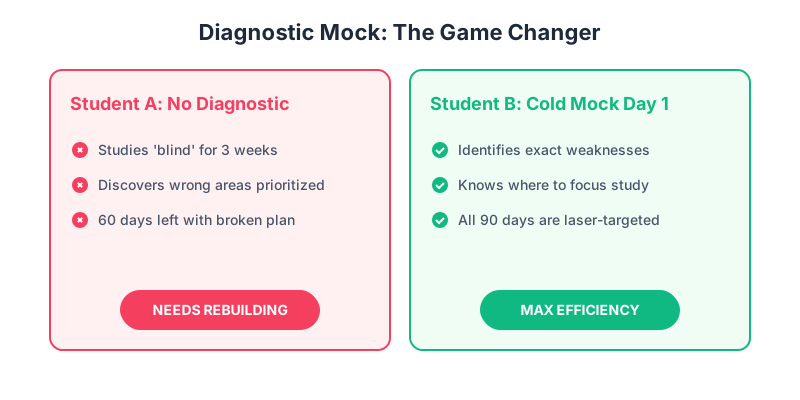
Consider two students, both with 90 days before their test date:
Student A spends the first three weeks reviewing arithmetic basics "just to be safe," then studies algebra, then geometry. After 30 days of studying, she takes her first practice exam and discovers that her Quant fundamentals were never the problem — her actual weakness is Data Insights, which she hasn't touched yet. She has 60 days left and a plan that needs rebuilding from scratch.
Student B takes a cold mock on Day 1. Her score is 35 points below her target. But she now knows that her Quant section is passable, her Verbal is strong, and her Data Insights — specifically Multi-Source Reasoning — is the section bleeding her score. On Day 2, she builds a plan that front-loads exactly what she needs. Every hour of her 90 days is targeted.
The cold mock costs you one afternoon. The alternative costs you weeks.
2. The Ego Trap
Here is the real reason most people delay taking the cold mock — and it is not logistics.
| Section | If score is low, it usually means… | First study priority |
|---|---|---|
| Quant | Forgotten fundamentals or broken word-problem setup | Arithmetic & algebra foundations, then word-problem translation |
| Verbal | Reading for content instead of argument structure | Evidence / conclusion / assumption mapping on every passage |
| Data Insights | Working-memory overload from multi-tab prompts | Ruthless information filtering + Data Sufficiency logic drills |
You haven't looked at algebra or probability since college. Your skills are rusty. And you are terrified of seeing a low score on the screen. The natural instinct is to say: "Let me just study the basics for a month, and then I'll take a diagnostic so I don't feel demoralised."
This is the ego trap. And it is costing you weeks.
An initial diagnostic test is not an assessment of your intelligence. It is not a prediction of your final score. It is a data-gathering exercise — the same kind a doctor runs before prescribing treatment, or a coach runs before designing a training programme. The number on the screen after your cold mock is simply information. It tells you where you are today, so you know what to do tomorrow.
Protecting your ego by avoiding the data doesn't make you smarter. It just makes your plan worse. There is a second version of this trap that is less obvious: studying "the basics" first to feel ready before testing. The problem is that a low score on a cold mock often has nothing to do with forgotten fundamentals — it usually reflects the format of the test, which no textbook review can replicate.
3. What the Cold Mock Actually Tells You
Beyond a score, a cold mock gives you three things that no study guide can provide.
- A personalised reality check on format. Every resource will tell you that the Quant section is 45 minutes long. No resource can tell you what 45 minutes feels like for you, with a real clock ticking in the corner of your screen. The cold mock introduces you to the psychological constraints of the test — and that introduction is worth more than any content review.
- An honest map of your weaknesses. Your weaknesses are not what you think they are. Students who assume they are weak at Verbal often discover their reasoning is intact — it is their reading speed that is the bottleneck. The cold mock shows you the actual gaps, not the ones you assumed existed.
- Momentum. Taking the exam demystifies it. Once you hit Submit, it stops being a monster and becomes a specific set of problems with specific patterns. That shift in mindset — from fear of the unknown to preparation for the known — is the psychological unlock that makes the rest of your prep possible.
4. The Rules of a Valid Cold Mock
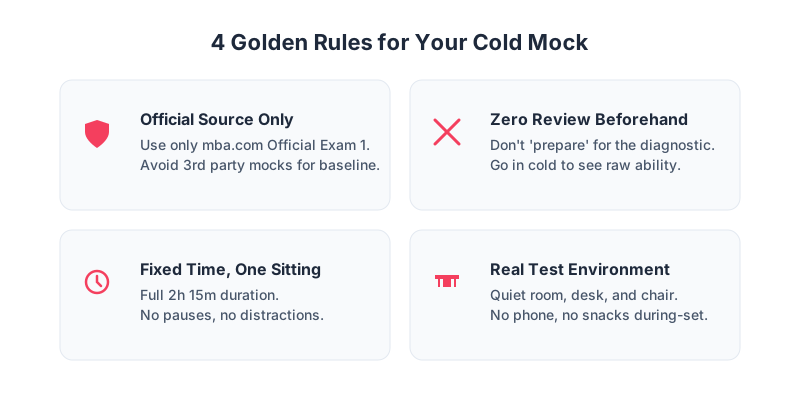
A cold mock only gives you useful data if you take it under conditions that reflect the real exam. Cutting corners here means your baseline is meaningless.
- Use the official source. Only use Official Practice Exam 1 from mba.com. Third-party mocks use their own scoring algorithms, which can give skewed results and unrepresentative question styles. The GMAT's adaptive algorithm is proprietary — only the official exams replicate it accurately enough to give you a trustworthy baseline.
- Do not review beforehand. Do not brush up on prime numbers the night before. Do not re-read your old notes on exponent rules. The entire point of a cold mock is to see what your brain retains naturally, without any recent priming.
- Take it in one sitting. The real exam is 2 hours and 15 minutes. No pausing the timer, no googling, no stepping away. If you get stuck on a question, make your best guess and move on — exactly as you would on test day.
- Mimic your intended test environment. If you are planning to test at a centre, take it at a desk, not on your couch. If you are considering the online exam, take it at home. The environment you test in shapes your performance in ways you won't notice until you've sat there for 90 minutes straight.
5. How to Read Your Results (Section by Section)
When you finish the test, the score on the screen will likely be below your target. That is expected and completely normal — this is a cold mock, not your final score. Take a breath, and then use the data.
If Quant was your lowest section: A low Quant score on a cold mock usually means one of two things. Either you have genuinely lost the foundational muscle memory for algebra and number properties, or your algebra is intact but your approach to word problems is broken — you can do the maths but you cannot translate a text-heavy problem into a clean equation. Look at which question types specifically cost you the most time, and that tells you which it is.
If Verbal dragged your score down: GMAT Verbal is a logic test, not a vocabulary or grammar test. A low Verbal score on a cold mock usually means you are reading passages to absorb content rather than to map argument structure. Your first priority is learning to strip an argument down to its core premise, conclusion, and assumption — mechanically, without bringing in outside knowledge.
If Data Insights felt overwhelming: DI intentionally overloads your working memory with tabs of information, tables, and graphs. The key skill is ruthless information filtering — learning to identify, in the first 20 seconds of a prompt, which tab you actually need and which ones are distractors. You also need to become comfortable with the counter-intuitive logic of Data Sufficiency, where you are never trying to solve the maths — you are only determining whether a definitive answer is possible.
If you ran out of time: Pacing problems are rarely about reading speed. They are almost always a symptom of the sunk-cost fallacy — spending six minutes on a question you should have guessed on after two minutes and thirty seconds. Your study plan needs to include explicit practice in cutting losses: setting a hard mental timer and moving on decisively, even when it feels wrong.
6. Your Next Move After the Diagnostic
Once you have your section scores and sub-section breakdown, the next step is to translate that data into a prioritised study plan. The instinct is to start with your weakest section and drill it into submission. This is often right — but not always. The structure of your plan depends on your score gap, your timeline, and which sections have the highest ceiling given your current baseline.
Use OpenPrep's diagnostic tool to get a sub-topic breakdown across all 30+ tested areas in the GMAT Focus Edition. Rather than knowing that "Quant is weak," you will know that "GMAT Quant sub-topic: Rates and Ratios — accuracy 42%, significantly below target." That level of specificity turns a vague study plan into a surgical one.
The cold mock removes the guesswork from your prep. Everything after it is just execution. Stop researching how to study — go get your baseline data. Come back with a number, and then we can build something real.