GMAT Algebra: Complete Strategy Guide
Quick Takeaways
- First Step: Always simplify the equation before solving.
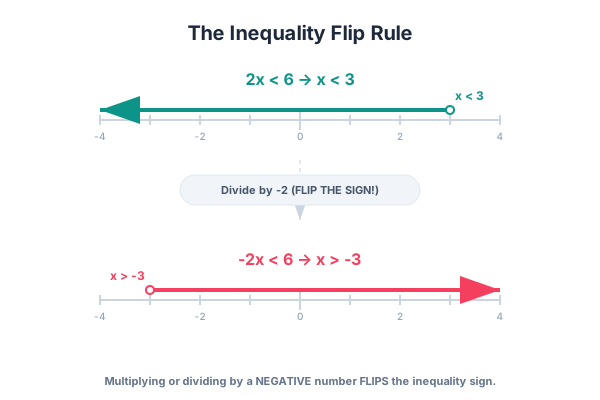
- The Flip: Multiply/Divide by negative = Flip inequality sign.
- Absolute Value: Always solve for 2 cases (positive & negative).
- Strategy: Plug in numbers (Substitution) for abstract variables.
- Shortcut: Work backwards from answer choices (Backsolving).
GMAT Algebra: More Than Just 'x' and 'y'
While Arithmetic forms the base of the GMAT Quant section, Algebra is where your reasoning skills are truly put to the test. Making up a significant portion of the section (around 40%), GMAT Algebra questions cover everything from simple linear equations to complex inequalities and absolute values. The GMAT uses algebra to create puzzles that require logical deduction, not just rote memorization of formulas.
Equations: The Foundation of GMAT Algebra
At its core, GMAT Algebra is about solving equations. You'll encounter two main types:
Linear Equations
These are the simplest form of equations, often with one or two variables (e.g., 2x + 3 = 11). The key skill here is isolating the variable through basic operations. Always remember to simplify equations by factoring out common numbers before you start solving (e.g., reduce 2x + 4y = 12 to x + 2y = 6).
Quadratic Equations
These are equations where the variable is squared (e.g., x² - 5x + 6 = 0). The GMAT will test your ability to solve these using two main methods:
- Factoring: This is the most common and fastest method. You'll need to be proficient at breaking down a quadratic into two binomials (e.g., x² - 5x + 6 = (x-2)(x-3)).
- The Quadratic Formula: For equations that can't be easily factored, you must know and be able to apply the quadratic formula: x = [-b ± sqrt(b² - 4ac)] / 2a.
Inequalities: The Tricky Art of Comparison
Inequalities are a favorite of GMAT question writers because they are full of traps for the unwary. They look like equations, but they behave differently. The most important rule to remember is the Flip Rule: whenever you multiply or divide both sides of an inequality by a negative number, you MUST flip the direction of the inequality sign. Forgetting this is the most common mistake test-takers make.
Absolute Values: The Two-Case Rule
The absolute value of a number is its distance from zero on the number line. Because distance is always positive, the absolute value of a number is always positive. When you see an absolute value in an equation or inequality, you must consider two separate cases.
- Equations: For an equation like |x + 1| = 12, you must solve for two possibilities: (x + 1) = 12 AND -(x + 1) = 12. This gives you two possible values for x.
- Inequalities: For inequalities, the process is similar. For |x - 2| > 3, you solve for both (x - 2) > 3 and (x - 2) < -3. For |2x - 7| < 5, you solve for both (2x - 7) < 5 and (2x - 7) > -5.
Key Strategies for GMAT Algebra
- Simplify, Simplify, Simplify: Before you do anything else, always see if you can simplify the equation or expression. This can turn a scary-looking problem into something much more manageable.
- Substitution (Plugging in Numbers): For abstract problems with variables in the answer choices, plugging in simple numbers (like 2, 0, or -1) can be a great way to test the choices and find the correct answer without doing complex algebra.
- Backsolving: For Problem Solving questions with numbers in the answer choices, you can often work backward. Plug the answer choices into the problem to see which one works. This can be faster than solving the equation from scratch.
- Use a Number Line for Inequalities: Visualizing the range of possible values on a number line is a powerful tool for solving complex inequality problems.
Functions and sequences: the often-skipped topics
Functions and sequences are listed in the GMAT Focus Edition official syllabus under Algebra but are frequently omitted from prep materials. They appear in roughly 1–2 questions per exam, often at the 650–750 difficulty level — exactly where score gains are most valuable. OpenPrep's Algebra question bank includes dedicated function and sequence question sets labelled by sub-type, so you can drill these specifically rather than waiting for them to appear randomly in a mixed practice session.
Functions
A function is a rule that maps an input to an output. GMAT function questions use notation like f(x) or the star operator (⊕). The key skill is not calculus — it is substitution.
- Standard notation: If f(x) = 2x² − 3, find f(4). Simply substitute: f(4) = 2(16) − 3 = 29.
- Custom operator: If a ⊕ b = (a + b) / (a − b), find 6 ⊕ 2. Substitute: (6+2)/(6−2) = 8/4 = 2.
- Compound functions: If f(x) = x + 1 and g(x) = x², find f(g(3)). Work inside-out: g(3) = 9, then f(9) = 10.
Sequences
The two sequence types tested are arithmetic sequences (constant difference between terms) and geometric sequences (constant ratio between terms).
| Type | Definition | nth Term Formula | Sum Formula | GMAT Example |
|---|---|---|---|---|
| Arithmetic | Each term increases by a fixed amount (d) | a + (n−1)d | n/2 × (first + last) | 3, 7, 11, 15, ... → d=4, 10th term = 3 + 9(4) = 39 |
| Geometric | Each term is multiplied by a fixed ratio (r) | a × r^(n−1) | a(1 − rⁿ)/(1 − r) | 2, 6, 18, 54, ... → r=3, 5th term = 2 × 3⁴ = 162 |
Visualising the inequality flip: a common source of errors