GMAT Critical Reasoning: A Complete Guide to Every Question Type
Critical Reasoning accounts for roughly one-third of your GMAT Focus Edition Verbal score. For most students, it is the section that responds most dramatically to the right preparation approach — and the one most commonly studied in the wrong way.
The wrong way looks like this: read a CR question, choose the answer that feels most logical, check the answer key, move on. When it is wrong, note the question type and flag it for review. Repeat.
This approach builds familiarity. It does not build logical precision. And the distinction matters enormously, because GMAT CR wrong answers are specifically engineered to feel plausible. They are constructed to attract students who are reasoning intuitively rather than analytically. The student who feels their way through CR will consistently score 60–70% on practice sets and plateau there, because their process does not distinguish genuine correct answers from well-crafted distractors.
This guide gives you a systematic approach: a four-step method for reading every CR question, a complete breakdown of every question type, a taxonomy of the three traps that account for the majority of wrong answers, and a concrete framework for using AI as a Socratic sparring partner to build real logical precision.
1. Why Most Students Approach CR Incorrectly
The mistake is treating CR as a comprehension exercise. Students read the argument, form a view on what seems most logical, and then scan the answer choices for the option that matches their intuition. The problem is that GMAT CR is not a test of what you believe is logical. It is a test of what the argument, as written, specifically supports or requires. The distinction is subtle but decisive.
The other common failure mode is bringing in outside knowledge. Students who know something about marketing, economics, or the specific industry in a CR argument often perform worse than students who do not, because their knowledge gives them grounds to evaluate the argument on external criteria rather than its internal logic. CR is always and only about the argument on the page.
2. The Structure of Every CR Argument
Before you can work with a CR argument, you need to map it. Every argument has the same basic structure:
- Evidence: the factual premises the author provides. These are treated as true — you do not evaluate whether the evidence is reliable. It is given.
- Conclusion: the specific claim the author is making based on the evidence. Always one bounded assertion — not the general topic, and not your paraphrase of what the author means.
- Assumption: the unstated premise that must be true for the evidence to support the conclusion. The assumption is the gap between what the evidence proves and what the conclusion claims. Almost all CR questions are fundamentally about this gap.
The single most important skill in CR is identifying the conclusion precisely. For example: "The city should prioritise building new parks because residents report that green space improves their wellbeing." The evidence is that residents report wellbeing benefits. The conclusion is that the city should prioritise new parks. The assumption is that building new parks is an effective way to deliver the wellbeing benefit — as opposed to improving existing parks, or that the reported benefit is significant enough to justify the cost.
Every time you read a CR argument, explicitly identify these three components before reading the answer choices. This step feels slow at first. It becomes fast quickly, and it prevents the error of evaluating answer choices without a fixed analytical anchor.
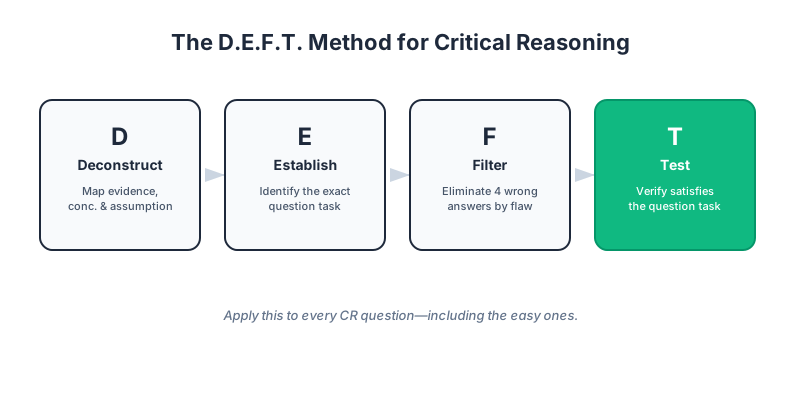
3. The D.E.F.T. Method
The D.E.F.T. method is a four-step process for approaching every CR question. It works across all question types because it is based on the logical structure that all CR questions share.
- D — Deconstruct the argument. Map the evidence, conclusion, and assumption before reading the question stem. Do not begin with the question — begin with the argument.
- E — Establish the question task. Read the question stem and identify precisely what you are being asked to do. "Which of the following most weakens the argument?" is a different cognitive task from "Which of the following, if assumed, allows the conclusion to be properly drawn?" Make the distinction explicit before evaluating any answer choice.
- F — Filter the choices. Work through each answer choice and look for a specific logical flaw that disqualifies it. The goal is not to find the best answer by comparative feel — it is to eliminate four answers because you can name their specific flaw, and accept the fifth because it has none.
- T — Test your answer. Before marking your choice, ask: if this answer is true, does it do exactly what the question task requires? For a Weaken question: does this genuinely damage the logical connection between evidence and conclusion? For an Assumption question: does negating this answer make the argument fall apart?
The Negation Test: For Assumption questions, negate your candidate answer and ask whether the argument now fails. If the negated version makes the argument illogical or unsupportable, the original answer is the correct assumption. If the argument still holds after negation, it is not a necessary assumption.
4. Every GMAT CR Question Type, Explained
The GMAT Focus Edition tests seven primary CR question types. Each has a specific logical task and a specific set of correct-answer characteristics.
Strengthen
What it asks: Which answer choice makes the argument's conclusion more likely to be correct? The logical task is to find an answer that supports the inference from evidence to conclusion — either by providing additional evidence, eliminating an alternative explanation, or closing a gap in the argument. Correct answers address the specific assumption the argument is relying on. Wrong answers are topically related but logically disconnected from the specific conclusion. Example: an argument concludes a new study habit causes score improvement because students who used it improved. A Strengthen answer might rule out that those students were already better to begin with — eliminating the selection bias gap.
Weaken
What it asks: Which answer choice makes the argument's conclusion less likely to be correct? The correct Weaken answer attacks the specific logical gap — it does not challenge the evidence itself (which is given as true). It shows the evidence could exist without the conclusion being true. Wrong answers are emotionally appealing as critiques but do not touch the specific logical structure. "The study was small" is a weak weakener unless sample size is the specific assumption the argument depends on.
Assumption
What it asks: Which answer choice is a necessary assumption the argument depends on? The correct answer is not 'a useful additional fact' but specifically the premise the argument requires to hold. Apply the Negation Test: take each answer choice, negate it, and check whether the argument falls apart. The correct answer, when negated, will make the argument logically fail. Common trap: answers that are sufficient assumptions (if true, they guarantee the conclusion) rather than necessary ones (required for the argument to work).
Evaluate
What it asks: Which answer would be most useful to know in order to evaluate whether the argument's conclusion is valid? The correct answer creates a genuine fork: if the answer is yes, the argument is stronger; if the answer is no, the argument is weaker. It goes directly to the specific assumption in the argument. Wrong answers are interesting or relevant to the general topic but do not address the specific logical gap.
Explain (Resolve the Paradox)
What it asks: The argument presents two facts that appear contradictory. Which answer explains how both can be true simultaneously? The correct answer introduces a mechanism or condition that makes both facts logically compatible. Wrong answers explain one fact but ignore or contradict the other. For an Explain question, both facts must remain true — an answer that 'solves' the paradox by making one fact false is always wrong.
Inference (Must Be True)
What it asks: Which answer choice must be true based on the information given? The critical standard is must be true — not probably, not plausibly, but necessarily. If you can construct any scenario where all the argument's statements are true and the answer is false, it is not correct. Wrong answers are likely true, or plausible, or consistent with the argument — but not necessarily true. The GMAT deliberately offers attractive inferences that go slightly beyond what the evidence strictly supports.
Boldface
What it asks: Two statements in the argument are in bold. Which answer correctly describes the roles both play? Classify each bolded statement as evidence, conclusion, intermediate conclusion, counter-argument, or background — and find the answer that accurately describes both. Wrong answers get one statement right but mischaracterise the other. Always evaluate both descriptions independently before accepting an answer.
5. The Three Most Common CR Wrong Answer Traps
Across all CR question types, wrong answers on the GMAT are constructed using three recurring flaw patterns. Recognising these patterns is a skill that develops with deliberate practice.
| Trap Type | Description | How to Identify It |
|---|---|---|
| Scope error | The answer introduces a concept, entity, or comparison not present in the original argument | Ask: does this answer deal with exactly what the argument is about, or does it introduce something new? |
| Direction error | The answer does the opposite of what the question task requires | For Strengthen: does this actually weaken? For Weaken: does this support the conclusion? |
| Irrelevance | The answer is factually plausible and topically related, but has no logical connection to the specific conclusion | Ask: even if this is true, does it change whether the conclusion follows from the evidence? |
If you can classify the flaw in each of the four wrong answers you eliminate, you are doing CR correctly. If you are choosing correct answers by feel — selecting the option that resonates most — you are building familiarity, not precision.
6. How to Use AI as a CR Sparring Partner
Conversational AI — GPT-4o, Claude, Gemini — is unusually well-suited to CR preparation because CR is fundamentally a dialogue about logic. The Socratic method, in which a tutor probes your reasoning rather than simply telling you the answer, is precisely what CR demands — and it is a method that human tutors often lack the time to apply consistently.
OpenPrep integrates a multi-model AI tutoring environment across all CR question types. Rather than marking your answer right or wrong and moving on, it asks you to articulate your reasoning: "Why did you eliminate this answer?" "What is the assumption in this argument?" "If you negate your candidate answer, does the argument fail?" The dialogue forces you to verbalise your logic — which is the fastest way to identify where your reasoning breaks down.
You can replicate this approach with any capable AI by using it as a Socratic sparring partner. The most effective use is not to have the AI explain the answer to you — any answer key can do that. It is to have the AI interrogate your reasoning before you know whether you are right.
7. A Sample AI Practice Session
The argument: A software company recently switched all employees to standing desks. In the six months following the switch, the company's average code output per developer increased by 18%. Therefore, standing desks improve developer productivity.
Your prompt to the AI: "I have a CR argument here. Before I give you my answer, ask me questions that test my understanding of its logical structure."
What to expect from the AI: It asks: "What is the specific conclusion of this argument?" → "What evidence does the author provide?" → "What must be true — but is not stated — for the evidence to support the conclusion?" → "What alternative explanation could produce the same evidence without the conclusion being true?"
By the time you have answered these questions, you have mapped the assumption (standing desks caused the increase, rather than some other change that happened simultaneously), identified the main vulnerability (causation vs. correlation), and clarified what a correct Weaken answer would need to do. Only then should you look at the answer choices — and eliminate each wrong answer by naming its specific flaw.
The goal of AI-assisted CR practice is not to get the answer faster. It is to slow down your reasoning until the logical structure becomes automatic — so that on test day, the structure is available to you under time pressure.
8. Building Consistent CR Accuracy
The progression from 60% to 80%+ accuracy on GMAT CR is not a content journey — it is a process journey. The content does not change. What changes is the rigour with which you execute the logical process on every question, including the easy ones.
The habits that distinguish high CR scorers: they map the argument before reading the answer choices — every time. They read the question task carefully and identify the specific logical operation required. They eliminate wrong answers by naming a specific flaw, not by comparison. They apply the Negation Test on Assumption questions. They never choose an answer because it sounds right.
Set a target: 30 CR questions per week, reviewed completely — not just wrong answers, but every wrong answer eliminated with a named flaw and every correct answer verified with the specific reason it satisfies the question task. At this pace, with this quality of review, most students see meaningful CR improvement within 4 to 6 weeks.