What is the GMAT Focus Edition? All You Need to Know (2026)
Quick Takeaways
- Shorter: 2h 15m total duration (down from 3h+).
- No Essay: The Analytical Writing section is gone.
- No Grammar: Sentence Correction is removed.
- New Section: Data Insights (DI) replaces IR and is equally weighted.
- Scoring: New 205-805 scale ending in 5.
- Edits: You can edit up to 3 answers per section.
GMAT Focus vs. Classic GMAT
| Feature | GMAT Focus (New) | Classic GMAT (Retired) |
|---|---|---|
| Total Time | 2 hours 15 minutes | 3 hours 7 minutes |
| Sections | Quant, Verbal, Data Insights | Quant, Verbal, IR, AWA |
| Scoring Scale | 205 - 805 (Ends in 5) | 200 - 800 (Ends in 0) |
| Section Order | Any order you choose | Limited options |
| Answer Editing | Change up to 3 answers | No editing allowed |
| Essay (AWA) | Removed ❌ | Included ✅ |
| Geometry | Removed ❌ | Included ✅ |
So, What's the Big Deal?
The GMAT Focus Edition is the most significant overhaul of the exam in 70 years. It’s leaner, faster, and more relevant to modern business. GMAC has stripped away the "academic" fluff (like geometry and obscure grammar) to focus intensely on critical thinking and data literacy.
With three 45-minute sections that are equally weighted, your ability to analyze data is now just as important as your ability to read passages or solve equations.
The Three Sections Explained
The GMAT Focus Edition is divided into three 45-minute sections. You can choose the order you want to tackle them in.
1. Quantitative Reasoning (21 questions)
This section tests your problem-solving skills using algebra and arithmetic. The big news? Geometry questions have been completely removed. It's all about how you apply math to real-world scenarios.
2. Verbal Reasoning (23 questions)
With Sentence Correction gone, this section is now purely about Reading Comprehension and Critical Reasoning. It evaluates your ability to read and understand arguments, not just your grammar prowess.
3. Data Insights (20 questions)
This is the new star of the show. It measures your ability to analyze and interpret data to make informed decisions. It combines questions from the old Integrated Reasoning section with Data Sufficiency questions. You also get an on-screen calculator for this section.
The Data Insights section is crucial—it's weighted equally with Quant and Verbal. Don't neglect it in your prep!
The New Scoreboard: Understanding 205-805
The new 205-805 scoring scale might seem odd, but it's designed to differentiate the Focus Edition from the old GMAT. Each of the three sections gets a score from 60 to 90. These are then combined to generate your total score.
| Score Range | Percentile | What it Means |
|---|---|---|
| 705+ | 99-100% | Highly competitive for top-tier MBA programs. |
| 655-695 | ~87-98% | Very competitive for most top 25 programs. |
| 605-645 | ~67-87% | A solid score for good MBA programs. |
| Below 605 | <67% | Might be worth retaking for top programs. |
Remember, your GMAT score is just one piece of the application puzzle. A strong profile can balance out a slightly lower score.
The Answer Editing Feature: A Game-Changer
One of the most significant operational changes in the GMAT Focus Edition is the ability to edit up to three answers per section. In the classic GMAT, once you confirmed an answer you could never revisit it. Now, if you finish a section with a minute or two to spare, you can flag up to three responses and change them.
This feature is best used defensively. The primary purpose is not to second-guess yourself — research consistently shows that first instincts on reasoning tests are more often correct than revised answers. Use it specifically for questions where you flagged uncertainty mid-section and ran out of time to think carefully.
- Flag as you go: Use the flag feature on questions where you guessed under time pressure
- Limit revisits to flagged questions only: Do not browse through all your answers — that wastes time
- Change only if you have a specific reason: 'I had more time' is not a reason. 'I misread the constraint' is
Choosing Your Section Order
Unlike the classic GMAT's limited ordering options, the Focus Edition lets you start with any of the three sections. This is a genuine strategic lever — not a gimmick.
| Profile | Recommended Order | Reason |
|---|---|---|
| Strong Quant, weaker Verbal | Data Insights → Quant → Verbal | Bank easy DI points first; end on Verbal when Quant fatigue peaks |
| Strong Verbal, weaker Quant | Verbal → Data Insights → Quant | Lock in Verbal before mental fatigue; fresh brain for hardest Quant |
| Balanced / unsure | Quant → Verbal → Data Insights | Classic order; most practice tests use this sequence |
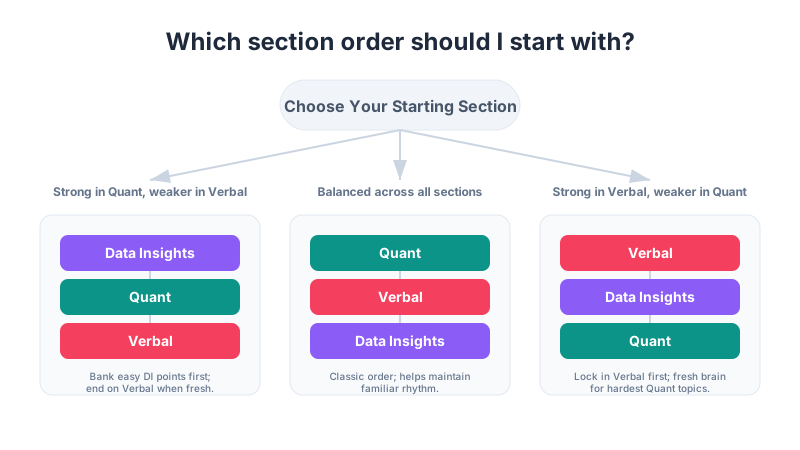
One practical note: always take your practice tests in the same section order you plan to use on test day. Your timing calibration and mental stamina pattern is sequence-specific.
How to Prep Without Freaking Out
Since the test has changed, your prep strategy should too. Here are a few tips:
- Focus on Data Insights: Since this section is new and heavily weighted, dedicate significant time to practicing data sufficiency, table analysis, and multi-source reasoning.
- Master Time Management: With only about two minutes per question, pacing is key. Use a timer during your practice sessions.
- Take Official Mock Tests: The best way to get a feel for the new format is to take official practice exams from GMAC under realistic conditions.
- Don't Ignore Your Weaknesses: Use your practice tests to identify your weak spots and focus your study time there.
- Leverage the Review Feature: Practice using the bookmark and review feature so it becomes second nature on test day. Know when to flag a question and when to move on.
- For a structured start: OpenPrep's free diagnostic is calibrated to the Focus Edition format and places you on the 205–805 scale in 60 minutes.