GMAT Graphics Interpretation: How to Read Charts and Graphs
Quick Takeaways
- First Step: Read Title, Axes, Units, and Legend BEFORE the question.
- Visuals: Understand Bar, Line, Scatter, and Bubble mechanics.
- Trap: confusing 'Percent Change' with 'Absolute Change'.
- Calc: Estimate first; use calc only if specific precision needed.
- Context: Don't ignore the text box describing the graph!
What are Graphics Interpretation Questions?
Graphics Interpretation (GI) questions, a key component of the GMAT Data Insights section, test your ability to read and analyze data presented in a visual format. You will be shown a graphic—such as a bar chart, line graph, or scatterplot—and then asked to fill in two blanks in a statement using dropdown menus. The task is to draw accurate conclusions based solely on the information provided in the graphic and its accompanying text. You must answer both parts correctly to get credit for the question.
Common Graph Types on the GMAT
Familiarity with the following graph types is essential:
- Bar Charts: Used to compare quantities across different categories.
- Line Graphs: Ideal for showing trends and changes over time.
- Pie Charts: Used to show proportions or percentages of a whole.
- Scatterplots: Used to show the relationship or correlation between two variables.
- Venn Diagrams: Used to show the overlap and relationships between different sets.
- Bubble Graphs & Flow Charts: Less common, but still testable formats that show relationships and processes.
A Step-by-Step Strategy for Success
To tackle GI questions efficiently, follow a consistent, methodical approach:
- Examine the Graphic First: Before reading the question, take 15-20 seconds to understand the 'big picture' of the graphic. Read the title, the labels on both axes, the units of measurement, and the legend. What story is the graphic trying to tell?
- Analyze the Question Stem: Carefully read the fill-in-the-blank statement. What specific information are you being asked to find? This will guide your analysis of the graphic.
- Locate the Relevant Data: Scan the graphic to find the specific data points needed to answer the question. This might involve reading a value off an axis, comparing the heights of two bars, or identifying a point on a scatterplot.
- Perform the Necessary Calculation (if any): The question may require a simple calculation, such as finding a percentage change, a ratio, or an average. Use your mental math and estimation skills to perform these calculations efficiently.
- Select Your Answers: Choose the options from the dropdown menus that match your findings. Double-check that you haven't misread the question or the graphic.
Common Traps and How to Avoid Them
- Misreading the Axes or Scale: This is the most common trap. Always double-check the units (e.g., thousands, millions, percentages) and the scale of each axis before you start interpreting the data.
- Confusing Percentage with Absolute Value: Be careful to distinguish between questions asking for an absolute change (e.g., 'an increase of $10,000') and those asking for a percentage change (e.g., 'an increase of 10%').
- Estimation Errors: While estimation is a useful skill, be wary if the answer choices are very close together. In these cases, a more precise calculation will be necessary.
- Ignoring the Text: Sometimes, a crucial piece of information needed to interpret the graphic is hidden in the small block of text that accompanies it. Always read this text carefully.
Chart-type specific strategies
Each chart type on the GMAT tests a slightly different visual reasoning skill. Knowing the specific traps for each type before test day eliminates the most common errors.
| Chart Type | Primary Skill Tested | Biggest Trap | First Action |
|---|---|---|---|
| Bar chart | Category comparison | Stacked vs. grouped bars — reading a stacked bar as if it shows absolute values of each segment | Check if bars are stacked or side-by-side before reading any value |
| Line graph | Trends over time | Dual y-axes — confusing which data series belongs to which axis | Read both y-axis labels before looking at the lines |
| Scatter plot | Correlation direction and strength | Conflating correlation with causation; outliers misread as representative of the trend | Identify the trend direction and locate the regression line or line of best fit first |
| Pie chart | Part-to-whole proportions | Confusing percentage share with absolute quantity | Always check: is the question asking for a percentage or an absolute number? |
| Box-and-whisker plot | Distribution shape and spread | Misidentifying skew — median closer to Q1 = right-skewed, not left-skewed | Find median first, then note its position within the box |
Worked example: scatter plot question
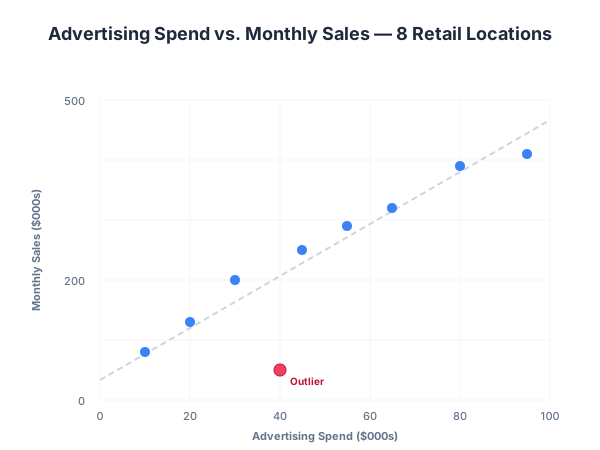
Sample question: "Based on the scatter plot, which of the following statements about the relationship between advertising spend and monthly sales is best supported?"
How to approach it:
- Read title and axes first (15 sec). What are x and y measuring? What units? "Advertising Spend ($000s)" and "Monthly Sales ($000s)."
- Identify the trend (10 sec). The data points slope upward left to right — a positive correlation. As advertising spend increases, monthly sales tend to increase.
- Note the outlier (5 sec). One point at approximately (40, 50) sits far below the trend line. This location will almost certainly appear in a drop-down question.
- Answer the drop-downs. Example: "The relationship between advertising spend and sales is [positive / negative / no correlation]." Answer: positive. "The data point that most deviates from the overall trend has an advertising spend of approximately [$40,000 / $80,000 / $95,000]." Answer: $40,000 (the outlier).
The causation trap: A positive correlation on this scatter plot means advertising spend and sales move together — it does NOT mean advertising spend causes higher sales. A question asking you to "conclude" that "spending more on advertising will always increase sales" is incorrect and out-of-scope. GMAT scatter plot questions test your ability to read the data, not to infer causation.
Pacing and time management for GI questions
Graphics Interpretation questions should take approximately 2 minutes each. The time investment should be front-loaded: spend 30–40 seconds reading the chart title, axes, units, and legend before touching the drop-downs. Students who skip this step frequently misread the axis scale or units and lose points they should have earned easily.
- 0:00–0:35: Read title, both axes, legend, and units. Build your mental model of what the chart shows.
- 0:35–0:55: Read the first drop-down statement. Identify which part of the chart it references.
- 0:55–1:20: Locate the data point(s). Make your calculation if needed (estimate first — use the calculator only if choices are very close).
- 1:20–2:00: Read and answer the second drop-down. Verify your answer makes sense against the chart.
Practising with real interactive charts: The most effective GI practice uses sortable, interactive chart interfaces rather than static images — because the actual test requires you to hover and read axes dynamically. OpenPrep's GI question bank uses interactive chart formats that mirror the test interface, building the habit of chart-first engagement from the start of your prep.