GMAT Online vs. Test Center: Which Format Is Right for You? (2026)
The GMAT Focus Edition is available in two delivery formats: at a Pearson VUE test centre, or online from your own computer at home. The exam content is identical — the same question types, the same adaptive algorithm, the same scoring scale, the same 2 hours and 15 minutes. From a pure testing standpoint, the two formats measure exactly the same thing.
But the experience of sitting the exam is meaningfully different between them, and those differences can affect your performance in ways that are easy to underestimate. The right format is not a matter of preference — it is a matter of matching the testing environment to your specific psychology, work situation, and home setup.
ISB, IIM-A, IIM-C, and several other top Indian programmes accept only test-centre based GMAT scores. If any of these programmes are on your list, the online format is not an option for you. Verify the requirements for every programme you are targeting before booking.
1. The Core Difference (It Is Not What Most People Think)
Most people assume the key difference between online and test-centre GMAT is convenience. That is partially true — but it is not the dimension most likely to affect your score. The dimension most likely to affect your score is familiarity and control over your testing environment.
At a test centre, every environmental variable is standardised: the room temperature, the monitor size, the desk height, the noise policy, the check-in process. You sit in a designated cubicle with noise-cancelling headphones available. The environment is impersonal and controlled — by design.
At home, you control the environment entirely — which is both an advantage and a risk. If your home workspace is genuinely quiet, well-lit, at a comfortable temperature, and free from interruptions for 2 hours and 15 minutes, the online format can feel calmer and more familiar. If any of those conditions are unreliable — family members, neighbours, internet instability, thin walls — the online format creates risks that the test centre eliminates.
2. Scratch Paper and the Whiteboard Problem
This is the most practically significant operational difference between the two formats, and the one that most affects students who are strong Quant performers.
At the test centre, you receive a physical notepad — laminated sheets with a marker that can be erased and reused — and you can request additional sheets from the proctor during the exam. You can lay it flat, write across it freely, and structure your scratch work exactly as you would on any paper surface.
Online, physical scratch paper is prohibited. You are permitted one physical whiteboard (maximum size 12 × 20 inches) with a dry-erase marker, or up to three erasable note boards per GMAC guidelines. Anything larger or non-erasable is a violation.
The whiteboard limitation matters for two reasons. First, if you rely on structured scratch work layouts — setting up equations across a full page, or columnar table setups for DI problems — the 12 × 20 inch constraint is genuinely limiting. Second, the whiteboard surface feels different to write on than paper, and the marker behaves differently from a pen.
If you plan to take the online exam: order your whiteboard now and use it for every single practice session from this point forward. Students who switch to the whiteboard in the final week typically report a 3 to 5 session adjustment period before it feels fluent. Do not encounter this friction on test day.
3. Scheduling and Flexibility
Test centre scheduling is constrained by Pearson VUE's availability at your nearest centre. In metro cities — Bangalore, Mumbai, Delhi, Hyderabad, Chennai — there are typically multiple centres, and appointment availability is generally reasonable 3 to 4 weeks out. In smaller cities, options are more limited.
Online scheduling is significantly more flexible. You can schedule an appointment as little as 24 hours in advance and can reschedule without penalty up to 24 hours before the appointment. For students managing unpredictable work schedules, this flexibility is a genuine advantage.
| Dimension | Test Centre | Online |
|---|---|---|
| Advance booking required | 3–4 weeks typical | As little as 24 hours |
| Cancellation window (free) | 7+ days before | 24+ hours before |
| Reschedule flexibility | Moderate | High |
| ISB / IIM-A / IIM-C eligible | Yes | No |
| Score cancellation option | Yes | Yes |
| Retake eligibility | Standard rules apply | Same as test centre |
One nuance worth noting: the flexibility of the online format can work against you if you tend toward procrastination. Knowing you can reschedule at any time is psychologically different from knowing you have a fixed, immovable appointment. The commitment that comes with booking a test centre date can be motivationally valuable.
4. The Proctoring Experience
Both formats are proctored — a human monitor watches your exam in real time — but the experience is quite different.
At the test centre, check-in is in-person. You will present your ID, have your palm vein or fingerprint scanned, undergo a metal detector check, and be escorted to your assigned cubicle. All personal items go in a locker. The proctor is physically present in the building.
Online, check-in is handled through the OnVUE platform, which you install in advance. The check-in process involves scanning your room with your webcam, photographing your ID, and confirming your workspace is clear of prohibited materials. This takes approximately 15 to 20 minutes. You must remain visible on camera at all times — standing up, leaving the frame, or talking are violations.
The online check-in process is the most common source of test-day stress reported by online GMAT takers. Technical problems with the OnVUE software, ID verification issues, or workspace concerns flagged by the proctor can delay your start by 20 to 40 minutes. Install OnVUE at least a week before your exam and run the full system check on the exact machine you will use on test day.
5. Environment Control and Noise
At the test centre, ambient noise is present but managed. Most centres provide noise-cancelling earmuffs on request, and the environment is designed for focused work.
At home, you bear full responsibility for managing ambient noise. Your proctor will flag any sounds that could indicate another person in the room or reference materials being used. Before booking the online format, run this honest checklist:
- Can I guarantee 2 hours and 15 minutes of uninterrupted, solo occupancy in my workspace?
- Is my internet connection stable — not just usually stable, but reliably stable for over two hours?
- Is there any ambient noise in my home environment during the time window I would test (construction, other family members, street noise)?
- Is my computer reliable, with adequate battery backup and no scheduled updates that could interrupt the session?
If you answered anything other than a confident yes to all four, the test centre is the lower-risk choice.
Whichever format you choose, start with a diagnostic mock under those exact conditions. OpenPrep's full-length practice exams replicate the GMAT Focus Edition's adaptive engine — so you can test your home setup or simulate a test-centre session and see how your score holds under real time pressure before it counts.
6. Score Reporting and Retakes
Score reporting works identically across both formats. You receive unofficial scores immediately at the end of your exam and can choose to accept or cancel them before leaving the test session. Retake rules are the same regardless of format: once per 16 calendar days, maximum 5 attempts in a rolling 12-month period, and 8 lifetime attempts total.
One important nuance: if your target programmes accept only test-centre scores, you cannot "test online first as a practice run" and then submit a test-centre score for the real application. Plan accordingly — your first real attempt should already be in the correct format for your target programmes.
7. Special Accommodations
If you require GMAT accommodations — extended time, a separate room, an ergonomic chair, a reader, a screen magnifier, or any other adjustment — the test centre is the correct choice. Accommodations are well-established and reliably implemented at Pearson VUE test centres globally.
Online accommodations are limited: extended time is the primary accommodation available. Complex accommodations requiring physical modifications to the test environment are not available online. If you require any accommodation beyond extended time, apply through GMAC's accommodations process and book a test-centre appointment.
8. How to Make the Final Decision
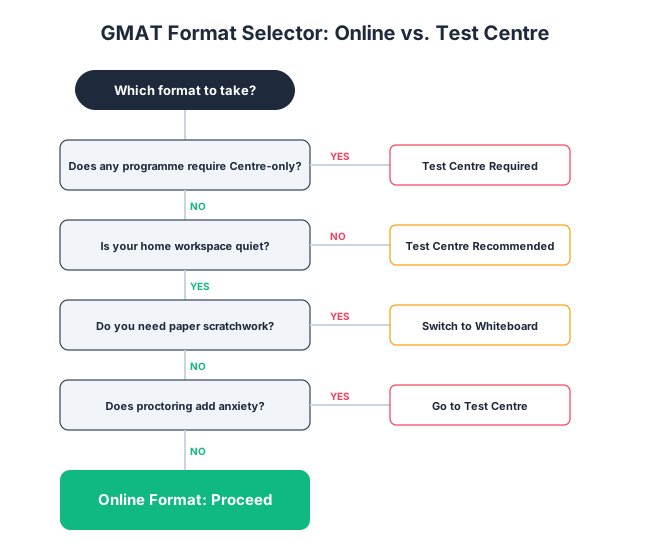
Run through this decision framework before booking:
- Check your target programmes. If any school requires a test-centre score (ISB, IIM-A, IIM-C, and others — verify with each), your format choice is made. Book a test-centre appointment.
- Assess your home environment honestly. Quiet, stable, uninterruptable for 2h15m? If yes, continue. If no, book the test centre.
- Assess your scratch work needs. Do you rely on structured, paper-based scratch work in Quant? If yes, either commit to whiteboard practice now (minimum 6 weeks of consistent use), or book the test centre.
- Assess your proctoring tolerance. Does remote check-in, webcam monitoring, and the possibility of technical problems add meaningful anxiety? If yes, the known, in-person test centre experience is lower-risk.
- Consider scheduling flexibility. If you need maximum flexibility due to an unpredictable work schedule, the online format's 24-hour booking window is a genuine advantage — provided Steps 1–4 are all clear.
The recommendation most GMAT tutors give their students: take at least one full practice mock in your intended test environment before the real exam. The format you perform consistently well in during practice is the format you should use on the real exam. Consistency across mocks is your most reliable signal.