Complete Guide to the GMAT Quant Section (Updated 2026)
Quick Takeaways
- Question Type: 100% Problem Solving (5-choice multiple choice).
- Format: 21 Questions, 45 Minutes, No Calculator allowed.
- Removed: NO Geometry, NO Data Sufficiency questions.
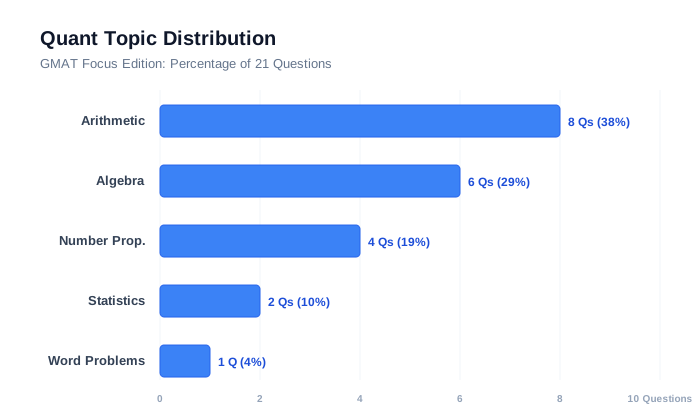
- Topics: Arithmetic (~8 Qs), Algebra (~6 Qs), Number Properties (~4 Qs).
- Strategy: Use 'Smart Numbers' and 'Work Backwards' to bypass algebra.
Question Types & Format
The GMAT Focus Edition Quantitative section contains 21 Problem Solving questions in 45 minutes. All questions are 5-choice multiple choice. No calculator is allowed—you must rely on mental math and scratch paper. Key changes: NO Geometry and NO Data Sufficiency questions. The section tests Arithmetic (~8 questions), Algebra (~6 questions), Number Properties (~4 questions), and Statistics.
Rules: Calculator NOT allowed for Quant (only available in Data Insights). Scratch paper and erasable booklet provided for calculations.
What Changed in GMAT Focus Edition
The GMAT Focus Edition brings the biggest change to the Quant section in decades. Data Sufficiency questions have completely moved to the Data Insights section. This means the Quant section is now 100% Problem Solving questions—no more "Statement 1 and 2" analysis.
Major Update: Geometry is completely REMOVED from the GMAT Quant section. Do not waste time studying triangles, circles, or coordinate geometry.
The total time is now 45 minutes for 21 questions (approximately 2 minutes per question). All questions follow a standard 5-answer multiple choice format.
Section Content & Topic Frequency
Based on recent GMAT Focus exam data, here is the approximate frequency of question types you will see on test day.
| Topic Category | Approx # of Questions | Priority Level |
|---|---|---|
| Arithmetic (Word Problems) | 7-8 | Critical |
| Algebra (Linear/Quad) | 5-6 | High |
| Number Properties | 3-4 | High |
| Statistics / Overlapping Sets | 2-3 | Medium |
| Powers & Roots | 1-2 | Low |
Arithmetic vs. Algebra Breakdown
The section is roughly split 60/40 between Arithmetic and Algebra. Arithmetic isn't just 'math'—it's logic. Expect to see complex word problems involving rates, work, ratios, and percentages.
| Arithmetic Topics | Algebra Topics |
|---|---|
| Rate & Work Problems | Linear Equations |
| Ratios & Percents | Quadratic Equations |
| Statistics (Mean/Median) | Inequalities |
| Set Theory (Venn Diagrams) | Functions & Sequences |
3 Strategies for a Q85+ Score
- Plug in Numbers (Smart Numbers): If the answer choices are variables (e.g., 2x, x+2), pick a simple number like 2, 3, or 5 for x. Solve the problem with real numbers. It's faster and less prone to specific algebra mistakes.
- Work Backwards: If the answer choices are numbers, try plugging them into the problem. Start with answer choice (C) (the middle value). logic tells you if you need a higher or lower number.
- Estimation: You don't get a calculator. The GMAT doesn't want you to do long division. If you see '3.14159 202', round it to '3 200' and look for an answer near 600.
Mental Math Tip: Memorize the decimal equivalents of fractions like 1/6 (0.166), 1/7 (0.142), 1/8 (0.125), and 1/9 (0.111). This saves valuable seconds.
Quant Pacing Guide: Question-by-Question
With 21 questions and 45 minutes, you have an average of 2 minutes and 9 seconds per question. But this average masks important structural variation: easy questions in the early adaptive phase should be faster (90 seconds), while harder mid-section questions will naturally take longer (up to 3 minutes).
| Question Range | Target Time Remaining | Pacing Status | Action if Behind |
|---|---|---|---|
| Q1-Q7 | ~30 min remaining | On track | Continue at current pace |
| Q8-Q14 | ~15 min remaining | On track | Continue at current pace |
| Q15-Q21 | ~0 min remaining | On track | Push slightly for Q19-Q21 |
| Q7 checkpoint | <28 min remaining | 2+ min behind | Guess on next hard question |
| Q14 checkpoint | <13 min remaining | 2+ min behind | Strategic guessing on any question over 90 sec |
Top GMAT Quant Traps and How to Avoid Them
The most reliable way to identify which of these traps are catching you personally is to review your error log after 30+ questions. OpenPrep's Quant error taxonomy tags each wrong answer with the specific trap type — "Integer Assumption Trap," "Average Speed Trap," "Percent Change Base Trap" — so you can see your personal trap pattern rather than treating all Quant errors as interchangeable.
The GMAT Quant section is designed with deliberate wrong-answer traps. Knowing the trap categories allows you to scan for and reject them even when short on time.
- The Almost-Right Calculation Trap: The correct answer is never the first thing your calculation produces. GMAT wrong answer choices are calculated using the most common arithmetic mistakes — off-by-one errors, forgetting to include zero, misapplied formulas. Always re-read the question after getting an answer
- The Integer Assumption Trap: The GMAT often leaves variable constraints implicit. If a question says 'x is positive,' many students assume x is also an integer. It is not unless explicitly stated — and 0.5 or 1/3 often breaks the intended reasoning
- The Average Speed Trap: Average speed ≠ (Speed₁ + Speed₂)/2. This trap appears 2-3 times per official practice test. Always use Total Distance ÷ Total Time
- The Percent Change Trap: Percent change is always relative to the original value, not the new one. A price that increases from $80 to $100 is a 25% increase — not 20%
- The Hidden Constraint Trap: In number property questions, constraints like 'even' or 'prime' are hidden in the problem setup. Skim for constraint words before setting up algebra
Building Your Quant Score Efficiently
The highest ROI activities for GMAT Quant improvement, in order of effectiveness:
- Error log by sub-topic — identify your 2-3 weakest sub-topics and drill them to 85%+ accuracy before moving on
- Timed drilling with a 2-minute timer — set a visible timer for every question, not just full-length tests
- Backsolving and Smart Numbers practice — these strategic shortcuts save 30-60 seconds per question on algebraic word problems
- Mental math drills — 10 minutes per day of arithmetic fluency (squares 1-20, common fraction/decimal conversions, divisibility rules) compounds over weeks