GMAT Reading Comprehension Strategy: How to Read for Structure, Not Speed
Quick Takeaways
- Paradox: Reading slower (for structure) makes you faster overall.
- Active Reading: Map the passage mentally; don't just scan words.
- Transitions: Focus on 'However', 'Therefore' to find the skeleton.
- Details: Ignore them on first pass; return only if asked.
- Goal: Understand WHY it was written, not WHAT facts it contains.
The Speed Paradox: Why Reading Slower Makes You Faster
If you're constantly running out of time on the GMAT Verbal section, your first instinct is probably to try and read the Reading Comprehension (RC) passages faster. This is a trap. The counter-intuitive secret to improving your RC speed is to read more carefully on the first pass. By investing 2.5-3 minutes to thoroughly understand the passage's structure and main idea, you save a massive amount of time on the back end, avoiding rereading and confidently eliminating trap answers. True speed comes from comprehension, not just moving your eyes quickly.
Myth-Busting: Ineffective 'Speed' Gimmicks to Avoid
Many test-takers fall for common 'tricks' that they believe will save time but ultimately hurt their score. You must avoid these:
- Skimming the Passage: Skimming causes you to miss essential details, logical flow, and the author's tone. This leads to confusion and forces you to hunt for information when answering questions, wasting precious time.
- Reading Only the First and Last Sentences: This is a popular but flawed strategy. GMAT passages are complex, and the main idea of a paragraph is often not in the first sentence. This gimmick will cause you to miss the entire context.
- Reading the Questions First: This encourages you to search for keywords instead of understanding the passage as a whole. The GMAT writers are experts at creating answer choices that contain keywords but twist the meaning, specifically to trap keyword-hunters.
The Core Strategy: Active Reading for Structure
Instead of passive reading, you need to become an active, engaged reader. Your goal on the first read is not to memorize details, but to create a mental map of the passage.
- Read for Purpose: After each paragraph, pause for five seconds and ask yourself, 'Why did the author write this? What function does this paragraph serve?' (e.g., 'to introduce a problem,' 'to provide a counterargument,' 'to give a supporting example').
- Focus on Logical Structure: Pay close attention to transition words like however, therefore, consequently, but, and although. These are the author's signposts, telling you where the argument is turning, contrasting, or concluding. They are the keys to the passage's logical skeleton.
- Summarize and Predict: As you read, mentally summarize the main point of each paragraph. Then, try to predict where the author is going next. This keeps you engaged and helps you anticipate the overall message.
Practical Tips for Efficient Reading
Passage mapping is a skill that improves fastest with immediate feedback on whether your map was accurate. OpenPrep's RC post-attempt explanations include an annotated passage structure breakdown — showing you how a high scorer would have mapped the same passage — so you can compare your mental model against the expert model directly after each attempt.
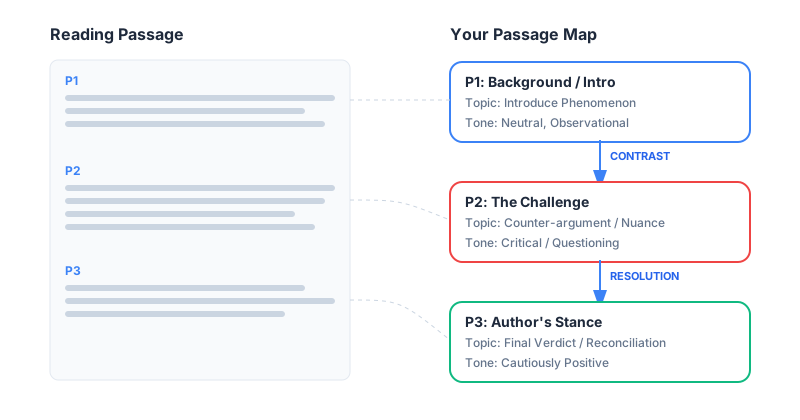
- Create a Passage Map: On your scratchpad, jot down a minimalist outline. For a three-paragraph passage, your notes might be as simple as: P1: Old theory explained. P2: New evidence challenges old theory. P3: Author suggests new theory is better. This map allows you to quickly locate details later without rereading the whole passage.
- Abbreviate Jargon: If a passage uses long, technical terms like 'social constructivism' or 'archaeopteryx,' give them a mental abbreviation (e.g., SC, Arch). Don't waste mental energy trying to pronounce them perfectly every time.
- Read for Pleasure: In your free time, read high-quality, complex material from sources like The Economist, The New Yorker, or Scientific American. This builds your reading stamina, improves your vocabulary, and makes dense GMAT passages feel less intimidating.
Building a Passage Map: Your RC Secret Weapon
A passage map is a brief mental (or written) outline of the passage's structure — not its content. Top RC scorers do not try to remember every fact in a passage; they remember the skeleton: what each paragraph does and how it relates to the next.
A passage map typically captures four things per paragraph:
- The topic of the paragraph (one or two words: 'historical context', 'counterargument', 'author's view')
- The purpose (does it introduce, support, contrast, or conclude?)
- The tone (positive, critical, neutral, uncertain?)
- Key transition words ('however', 'despite', 'therefore') that signal a shift
Approaching RC Questions by Type
Each RC question type requires a slightly different approach. Applying the same strategy to all question types is one of the most common RC mistakes.
| Question Type | Where to Look | Common Trap | Time Target |
|---|---|---|---|
| Main Idea / Primary Purpose | First + last sentences of passage | Too narrow (one paragraph only) | 60-75 sec |
| Detail / Specific Reference | Passage keyword scan + target paragraph | Out of scope / not stated | 75-90 sec |
| Inference | Paragraph containing the referenced detail | Too strong / goes beyond text | 90-120 sec |
| Tone / Author's Attitude | Signal words throughout passage | Extreme language (always, never) | 60-75 sec |
| Logical Structure | Paragraph function, not content | Confusing what vs. why | 90-120 sec |