GMAT Test Anxiety: Your Science-Backed Playbook for a Higher Score
You have been scoring 695 on your practice tests. You know the material. You walk into the test centre on the real day, sit down, and something happens: your heart accelerates, your working memory seizes, and a Data Insights prompt you would solve in two minutes on a Tuesday suddenly makes no sense at all.
This is not a content problem. No amount of additional practice questions would have prevented it. What you are experiencing is the physiological response to high-stakes pressure — and it is fixable, but only if you treat it as a separate skill to develop, not as a personality flaw to push through.
GMAT test anxiety is the most common reason that well-prepared students underperform on the real exam. Research consistently shows that test anxiety impairs working memory — which is precisely what the GMAT tests. A student who manages their anxiety well on test day can perform at or above their practice average. A student who does not may drop 30 to 50 points below it.
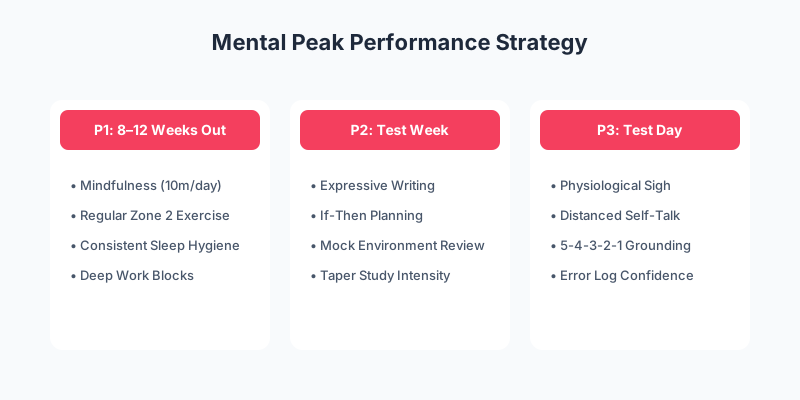
This guide covers what to do 8–12 weeks out, what to do in the final week, and what to do at your desk when the pressure is on. These are not motivational tips — they are research-backed techniques drawn from cognitive psychology, neuroscience, and performance training. Use them as a system, not a menu.
1. Why Smart, Prepared Students Still Underperform
The mechanism behind test anxiety is well-established. When you perceive a situation as threatening — and a high-stakes exam with significant career implications is genuinely threatening — your brain's threat-detection system triggers a stress response. Cortisol and adrenaline flood your system, preparing your body for physical action.
This response is useful if you are being chased. It is actively harmful during a logic test, because the stress response competes directly with the prefrontal cortex — the part of your brain responsible for abstract reasoning, working memory, and analytical thinking. Under acute anxiety, cognitive resources that should be available for solving problems are diverted to managing the threat response.
The result is not that you "forget" what you studied. It is that the mental bandwidth required to hold multiple variables in mind while reasoning through a Data Insights problem is temporarily reduced. You read the same sentence three times and absorb nothing. You second-guess an answer you know is correct.
The students who consistently score at or above their practice average on the real exam are not students with less anxiety. They are students who have built specific, practised responses to the anxiety when it arrives.
2. Long-Term Anxiety Management (8–12 Weeks Out)
You cannot learn to manage exam anxiety the night before the test. Like any skill, the underlying nervous system adaptation requires consistent practice over weeks.
Mindfulness — 10 Minutes Per Day
A 2024 meta-analysis in Frontiers in Psychology found mindfulness practice has a large, statistically significant effect on reducing test anxiety across student populations. For GMAT prep specifically, this translates directly: the ability to catch yourself when your mind has drifted during a Reading Comprehension passage and redirect attention without spiralling into self-criticism is a trainable skill. Start with five minutes per day using a structured app. The goal is not to have a blank mind — it is to notice when attention wanders and practise the act of returning it. The noticing and returning is the exercise.
Exercise — 3 to 4 Sessions Per Week
Just 20 to 30 minutes of moderate aerobic exercise significantly reduces baseline cortisol levels and increases BDNF — a protein that supports learning, memory consolidation, and cognitive flexibility. The practical implication: a student who exercises regularly walks into the test centre with a substantially lower baseline stress level. Running, cycling, swimming, or brisk walking all produce the effect. Three to four sessions per week for 20–30 minutes each is sufficient.
Sleep — Consistent Bedtime, Not Just Duration
Sleep deprivation increases amygdala reactivity by up to 60%, meaning the threat-detection part of your brain becomes significantly more sensitive under poor sleep. The most impactful change most students can make is not sleeping longer — it is sleeping consistently. A regular bedtime and wake time, maintained even on weekends, significantly improves sleep quality. Sleep is also when your brain consolidates what you studied — the GMAT content you reviewed on Tuesday is more durably encoded by Wednesday morning if your sleep was uninterrupted.
Deep Work Training — Building Sustained Focus
The GMAT is 2 hours and 15 minutes of sustained analytical effort. Most students' daily work lives involve interruptions every 5–15 minutes. Start your prep sessions with deliberate deep work blocks: a timer set to 25 minutes, phone in another room, a single GMAT task. Gradually extend these blocks toward 45–50 minutes — the length of a GMAT section. The goal is to develop stamina for sustained focus, not just ability to solve individual problems.
3. Test-Week Protocols (7 Days Out)
| Technique | When to Use It | Time Required |
|---|---|---|
| Mindfulness practice | 8–12 weeks out, daily | 10 min/day |
| Aerobic exercise | 8–12 weeks out, 3–4×/week | 20–30 min/session |
| Expressive writing | Final week + test morning | 10 min |
| If-then planning | Night before the exam | 15 min to write |
| Physiological sigh | At your desk, between questions | 15 seconds |
| 5-4-3-2-1 grounding | When spiralling mid-exam | 60 seconds |
The week before your exam is not for cramming new content. It is for consolidation, mental preparation, and preserving the gains you have already built.
Expressive Writing — The Pressure-Release Technique
A study published in Science (2011, Ramirez and Beilock) found that students who spent 10 minutes writing down their specific anxieties and worries immediately before a high-stakes exam performed significantly better than students who did not. The mechanism is cognitive offloading: by externalising the anxious thoughts onto paper, you free working memory capacity that would otherwise be occupied by managing those thoughts.
In the final week, set a timer for 10 minutes and write uncensored about your specific GMAT concerns — not generic worries, but specific ones: "I am worried I will freeze on the first DI question and never recover." The more specific, the more effective the release. On test day, if scratch paper is available before the session begins, do a shorter 5-minute version.
If-Then Planning — Scripting Your Responses
Elite performers across sports, military, and high-stakes professional contexts use implementation intentions: pre-scripted, automatic responses to specific triggers. Write yours before the exam:
- If I feel my heart starting to race, then I will do two physiological sighs before reading the next question.
- If my mind goes blank on a question, then I will reread the question stem twice, slowly, before doing anything else.
- If I start thinking about how I did on the last section, then I will do a 5-4-3-2-1 grounding exercise and return to the current question.
- If I am still stuck after 2 minutes 30 seconds, then I will make my best guess and move on without looking back.
Write your if-then plans on paper before the exam — do not keep them only in your head. The physical act of writing them makes them more durable under pressure.
4. Test-Day Strategies You Can Use at Your Desk
The Physiological Sigh — Your Fastest Reset
The physiological sigh is a double-inhale breathing pattern studied extensively at Stanford's Huberman Lab. It is the fastest known technique for downregulating the sympathetic nervous system in real time. The mechanism: the double inhale reinflates the air sacs in your lungs that have partially collapsed during shallow stress breathing. The slow exhale activates the parasympathetic nervous system through the vagus nerve, triggering a rapid calming effect.
- Take a deep inhale through your nose.
- At the very top of that inhale, take a small secondary inhale to fully fill the lungs.
- Exhale slowly and completely through your mouth.
- Repeat 2 to 3 times.
The full sequence takes approximately 15 seconds. You can do it silently between questions or at the start of a section. It will not eliminate anxiety, but it will measurably reduce its intensity within 30 to 60 seconds.
Distanced Self-Talk — Speaking to Yourself By Name
Psychologist Ethan Kross at the University of Michigan has demonstrated that self-talk in the third person — using your own name or "you" rather than "I" — creates psychological distance that improves emotional regulation and performance under pressure. When you notice yourself thinking "I'm panicking, I can't do this," reframe it as "[Your name], you're feeling anxious right now. That's fine. Focus on the next sentence of the question stem." This is not positive thinking — it is a cognitive reframing technique that reduces the intensity of the emotional experience by creating distance from it.
The 5-4-3-2-1 Grounding Technique
If anxiety escalates to the point where you are spiralling — replaying the last section, catastrophising about your score, or losing the thread of the current question — this technique interrupts the loop by forcing present-moment sensory awareness. Silently, in your head: name 5 things you can see, 4 things you can physically feel, 3 things you can hear, 2 things you can smell, 1 thing you can taste. Anxiety is almost always future-oriented. Grounding forces your brain into the present sensory moment, breaking the spiral enough to return attention to the task.
5. How to Use Your Breaks Effectively
The GMAT Focus Edition allows one optional 10-minute break. Most students use it incorrectly — they check their phone, review their performance on the previous section, or sit passively while their anxiety compounds. Your break is not rest. It is active recovery. Use it as a structured three-step reset:
- Reset (2–3 minutes): Stand up immediately. Shake out your hands and roll your shoulders. Do 2–3 cycles of box breathing: inhale for 4 counts, hold for 4, exhale for 4, hold for 4. This downregulates your nervous system after the exertion of sustained focus.
- Refuel (3–4 minutes): Eat your pre-planned snack — ideally something with a stable glucose profile, like nuts or a banana. Drink water. Avoid anything that will spike your blood sugar sharply.
- Refocus (1–2 minutes): Before you walk back into the testing room, say your reset phrase to yourself: "Fresh section. I know this material. Next question." Do not analyse what happened in the previous section. Your score on the next section is unaffected by what happened in the last one.
6. Building Your Personal Anxiety Toolkit
The techniques above are not all equally effective for every person. The right toolkit is the one that works for your particular anxiety profile — and the only way to know what works is to practise under simulated pressure before the real exam.
In the 4–6 weeks before your exam, take at least two full-length practice mocks under conditions that approximate test-day stress: an unfamiliar space, no pauses, phone away. After each mock, note which anxiety-management techniques you used and whether they were effective. Build your personal playbook from actual evidence, not assumption.
OpenPrep's mock tracking tool lets you log how you felt across each section of a practice exam — not just your score. Over time, this creates a map of which conditions increase your anxiety and which reduce it, giving you data to refine your approach before it matters.
Anxiety management is a skill. It requires deliberate practice, not just intention. Build your toolkit starting today — not the night before your exam. The students who manage test-day anxiety best are not the ones with the calmest personalities. They are the ones who prepared for it as specifically as they prepared for Data Sufficiency or Critical Reasoning.