How Many Hours Should You Study for the GMAT?
Quick Takeaways
- Benchmark: Aim for 15 high-quality hours/week.
- ROI: ~7 hours study ≈ 10 point improvement.
- Total: 50-80 pt gain needs ~180 hours.
- Quality: 10 focused hours > 20 distracted hours.
- Consistency: Daily micro-sessions beat weekend cramming.
The Magic Number: The 15-Hour Rule
If you're looking for a general benchmark, most GMAT experts agree that 15 hours of focused study per week is the sweet spot for making consistent, meaningful progress. This amount of time is substantial enough to learn new concepts and practice them, but manageable enough for most working professionals to sustain over a period of 3-6 months without completely burning out. For a full-time student, this number can be higher, around 20-30 hours per week.
It All Depends on Your Score Goals
The total number of hours you need is directly tied to how much you want to improve your score. Here's a rough breakdown based on data from GMAT prep providers:
| Score Improvement Needed | Approx. Total Study Hours | Time on a 15-Hour/Week Schedule |
|---|---|---|
| 50-80 points | ~180 hours | ~3 months |
| 100-150 points | ~300 hours | ~5 months |
| 150+ points | ~360+ hours | ~6+ months |
Keep in mind that these are averages. If you're a faster learner or have a strong academic background, you might need fewer hours. Conversely, if you've been out of school for a while, you may need more time to get back into the swing of things.
A good rule of thumb from some experts is to budget about 7 hours of study for every 10-point increase you want to achieve on the GMAT Focus scale.
What Does 15 Hours a Week Look Like?
Fitting 15 hours of study into a busy week requires a concrete plan. Here are two sample schedules for a working professional:
The 'Early Bird' Schedule
- Mon-Fri: 1.5 hours in the morning (e.g., 6:30 AM - 8:00 AM). (7.5 hours total)
- Saturday: 4 hours in a focused block.
- Sunday: 3.5 hours in a focused block. (7.5 hours total)
- Weekly Total: 15 hours
The 'Night Owl' Schedule
- Mon-Thurs: 2 hours in the evening (e.g., 7:00 PM - 9:00 PM). (8 hours total)
- Friday: Off for a well-deserved break.
- Saturday: 4 hours in a focused block.
- Sunday: 3 hours in a focused block. (7 hours total)
- Weekly Total: 15 hours
The Golden Rule: Quality Over Quantity
It's crucial to understand that 15 hours of distracted, low-energy studying is far less effective than 10 hours of deep, focused work. How you study is just as important as how long you study.
- Avoid Burnout: Don't try to study when you're exhausted. It's better to get a full night's sleep and wake up early than to force a late-night session when your brain is fried.
- Schedule Breaks: Plan for one full day off per week to rest and recharge. This prevents mental fatigue and helps with long-term retention.
- Be Active, Not Passive: Don't just read or watch videos. Actively solve problems, create flashcards, and analyze your mistakes. Active learning is far more effective for the GMAT.
How to Allocate Your Study Hours
Total study hours matter less than how those hours are distributed across activities. Many students spend 80% of their time doing practice questions and 20% reviewing them — the opposite of what high scorers do.
| Activity | Recommended % of Time | What It Builds |
|---|---|---|
| Conceptual learning (first month) | 30% | Foundation: rules, frameworks, question types |
| Timed practice (all months) | 35% | Speed, accuracy under pressure |
| Error review and log | 25% | Pattern recognition, mistake elimination |
| Full-length mock tests | 10% | Stamina, pacing, test-day simulation |
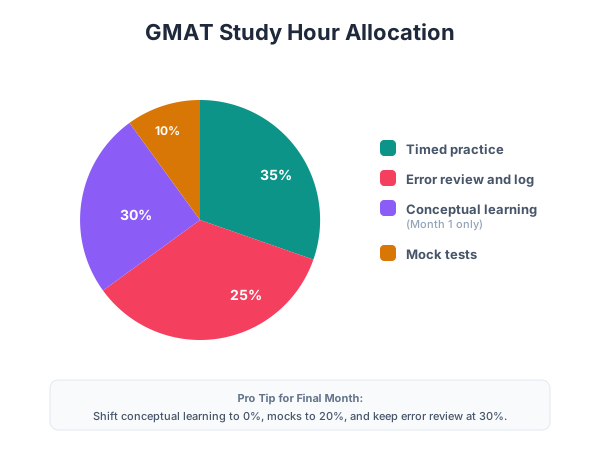
In the final month of preparation, the allocation should shift: reduce conceptual learning to near zero, increase mock tests to 20%, and keep error review at 30%. You are no longer learning new skills — you are refining and stamina-building. OpenPrep's analytics dashboard tracks your time distribution across activity types automatically — so you can verify whether your actual hour allocation matches your intended allocation without maintaining a manual study log.
Study Time Mistakes That Kill Your Score
- Re-doing questions you already got right. This feels productive but has zero learning value. Every practice session should prioritise your known weak areas
- Studying in 20-minute fragmented windows. Reasoning skills require sustained focus. Below 45-minute sessions, your brain barely reaches the depth of engagement the GMAT demands. Protect 60-90 minute blocks
- Skipping mock tests to 'save' them. Full-length tests are your most accurate score signal. Taking too few means you miss pacing calibration and stamina issues that show up only in 2+ hour sessions
- Counting question quantity as progress. 50 questions reviewed deeply with error logging beats 200 questions skimmed. Track accuracy by sub-topic, not questions completed