How to Fund Your MBA in 2026: Scholarships, Loans, and Employer Sponsorship
The sticker price of an MBA — ₹25–35 lakhs for an IIM, $80,000–$150,000+ for a top US school — is real. But it's almost never what most students actually pay. Between merit scholarships, need-based aid, school-specific fellowships, education loans with deferred repayment, and employer sponsorship, the majority of MBA students have access to funding options they never fully explored.
The problem is timing and research. Most applicants focus all their energy on GMAT scores and application essays, and treat funding as an afterthought. By the time they're admitted, they've missed scholarship deadlines, haven't approached their employer, and end up taking the first loan offer without comparison shopping. This guide walks through every funding source available in 2026 — with specific amounts, deadlines, and the right sequence to approach them.
Quick Takeaways
- Apply for school merit scholarships simultaneously with your admission application — they use the same materials.
- Indian need-based scholarships (IDFC First Bank, ONGC) have specific income cutoffs and early deadlines — research eligibility now.
- HDFC Credila and Avanse are India's best education loan options for MBA abroad — better rates than most public banks for foreign programs.
- SBI Scholar Loan covers IIMs at up to ₹40L with no collateral required for these institutions.
- Employer sponsorship is underused — even partial tuition reimbursement (30–50%) dramatically changes the loan burden.
- A 700+ GMAT score directly unlocks merit scholarships at most schools — it is the highest-ROI investment you can make.
The Four Funding Pillars
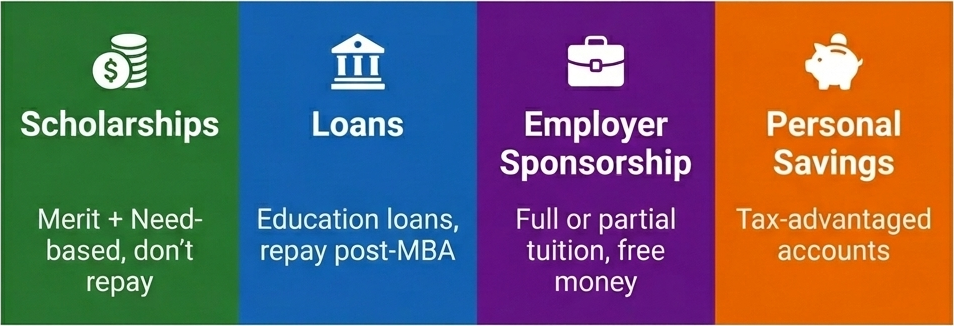
Most MBA students use a combination of sources rather than a single funding stream. Think of your total funding as a puzzle with four pieces: scholarships (money you don't repay), loans (money you repay after graduation), employer sponsorship (often partial, but free), and personal savings. The goal is to maximise the no-repayment portion before calculating how much loan you actually need.
A well-funded MBA strategy starts with research 12–18 months before your target start date — not after you receive your offer letter. By that point, many scholarship windows have closed and the best loan rates require documentation that takes months to prepare.
Scholarships for Indian MBA Students
India has a surprisingly rich scholarship ecosystem for MBA students — most of it under-promoted. The key is knowing the eligibility filters (income limits, gender, category, school-specific) before you apply, so you don't waste time on scholarships you don't qualify for.
| Scholarship | Type | Amount | Eligibility | Deadline (Approx.) |
|---|---|---|---|---|
| IDFC FIRST Bank MBA Scholarship | Need-based | Up to ₹2L (₹1L/year for 2 years) | Indian national, first-year 2-year MBA, gross family income ≤ ₹6L/year, enrolled in one of 118 listed colleges | June 30, 2026 |
| ONGC Scholarship | Need-cum-merit | ₹48,000/year | Min 60% in graduation, family income < ₹2L/year (SC/ST: < ₹4.5L/year), 50% seats reserved for women | August (varies) |
| T. Thomas Scholarship (IIM Ahmedabad) | Merit-cum-means | ~₹1L/year (second year) | Second-year IIM-A PGP students with financial need and strong academic performance | Announced after first-year results |
| IIM-A Need-Based Financial Assistance | Need-based | Tuition reimbursement up to full fees | Family gross income < ₹15L/year; awarded in both years | At admission stage |
| IIM-A Peri Viswanath Scholarship | Merit-cum-means | ₹4L over 2 years | Family income < ₹15L/year; awarded at start of second year | During first year |
| ISB Merit Scholarships | Merit-based | Partial to full tuition (varies widely) | Top GMAT/GRE scorers, exceptional work experience or research background | With application |
For IIM and ISB programs, the school itself is the primary source of scholarship funding. Apply for financial aid at the same time as your admission application — most schools require a separate financial aid form. Missing this form deadline means missing the scholarship cycle entirely, even if you receive admission.
International MBA Scholarships for Indian Students
If you're targeting an MBA abroad (US, UK, Europe), the scholarship landscape is significantly larger — but also more competitive. Most top schools offer merit scholarships to their highest-ranked applicants automatically, and many have dedicated diversity fellowships for Indian and South Asian applicants.
| Scholarship | School / Programme | Amount | Key Requirement |
|---|---|---|---|
| Forte Foundation Fellowship | Partnered MBA programs (30+ US schools) | Varies by school | Identifies as a woman; strong GMAT; leadership background |
| Consortium for Graduate Study in Management | Consortium member schools | Full to partial tuition + fee waiver | Underrepresented minorities; strong academic record |
| Wharton MBA Fellowship | Wharton School (UPenn) | Varies | Merit-based; awarded at admission — no separate application |
| Booth Fellowship | Chicago Booth | Varies | Merit-based at admission + need-based options available |
| Tuck Bridge Program Scholarship | Tuck at Dartmouth | Merit-based | Strong GMAT and academic record |
| INSEAD MBA Scholarships | INSEAD (France/Singapore) | €5,000–€30,000 | Merit + diversity; multiple rounds; apply with admission |
| London Business School Dean's Scholarship | LBS | Up to £15,000 | Academic excellence; applied with admission |
At US schools, the most reliable way to unlock merit scholarships is a strong GMAT score. Many schools publish a GMAT scholarship matrix internally — applicants above the class median GMAT by 20+ points are often considered for automatic merit awards. A 740+ GMAT at a school with a 715 median can trigger a $30,000–$60,000 scholarship at Tier 2 schools. This is why your GMAT score is the highest-ROI investment you can make for MBA funding. For Indian applicants, a strong GMAT Focus score is especially high-leverage for ISB's merit scholarship consideration and for triggering automatic scholarship review at US T2 schools where even a 20-point improvement above the class median can activate a $20,000–$40,000 award. A targeted OpenPrep diagnostic shows you specifically how far you are from the scholarship-threshold score at your target programmes.
Education Loans in India: Your Best Options in 2026
India's education loan landscape has improved significantly in the last five years. NBFC lenders like HDFC Credila and Avanse have largely replaced public banks as the preferred option for MBA abroad, offering faster processing, less collateral, and more flexibility around repayment. For domestic Indian MBA programs (IIMs, ISB), SBI's Scholar Loan scheme remains the gold standard.
| Lender | Best For | Max Loan Amount | Collateral | Interest Rate (Approx.) | Key Feature |
|---|---|---|---|---|---|
| HDFC Credila | MBA abroad (US, UK, Europe) | Up to ₹75L for foreign programs | Property / co-borrower for large amounts | 10.5–12% (floating) | Fastest processing in India; branch offices in major cities; loan approval often within 10–14 days |
| Avanse Financial Services | MBA abroad, top Indian programs | Up to ₹75L | Property / co-borrower | 11–13% (floating) | Covers living expenses, travel, equipment in addition to tuition; flexible moratorium |
| SBI Scholar Loan | IIM PGP, XLRI, MDI, other top Indian MBAs | Up to ₹40L | No collateral for listed premier institutions | 8.5–9.5% (repo-linked) | Subsidised rate for scheduled institutions; government-backed scheme |
| PNB Education Loan | Domestic and foreign MBA | Up to ₹7.5L (unsecured); higher with collateral | Required for amounts above ₹7.5L | 9–10.5% | Interest subsidy scheme for economically weaker sections |
| Axis Bank Education Loan | Foreign MBA programs | Up to ₹75L | Required for amounts > ₹40L | 10.5–13% | Relationship banking discounts available for existing Axis customers |
| Prodigy Finance | Top-ranked international MBAs (US, UK, Europe) | Up to $220,000 USD | No collateral required | 7–15% depending on profile | No collateral, no co-signer required; repayment begins after graduation; widely accepted by US schools |
Compare total cost of borrowing, not just the interest rate. A loan with a lower headline rate but shorter repayment period may cost more per month than a slightly higher-rate loan with a 10-year repayment. Always ask for the EMI schedule at multiple loan tenures before signing.
US Federal Loans for International Students
US Federal student loans (FAFSA-based) are generally not available to international students unless they are US permanent residents or citizens. Most Indian applicants studying in the US use private lenders — either Indian NBFCs (HDFC Credila, Avanse) or international platforms (Prodigy Finance, MPower Financing). Some US schools also have institutional lending programs for international students.
- Prodigy Finance: Co-signer and collateral-free loans for students at 750+ top schools worldwide. Widely used by Indian students at US top-10 MBA programs. Repayment starts 6 months after graduation.
- MPower Financing: Similar to Prodigy; targets international students at 400+ North American schools. Fixed interest rate option available.
- School Institutional Loans: Some US schools (Harvard, MIT, Wharton) operate their own lending programs for admitted international students, often at preferential rates. Ask your financial aid office specifically about this option after admission.
Getting Your Employer to Fund Your MBA
Employer sponsorship is the most underused funding source among MBA applicants — particularly in India, where the culture of asking employers for educational support is less common. Yet many companies, especially large multinationals, consulting firms, and BFSI companies, have formal or informal tuition reimbursement programs that can cover 30–100% of MBA costs.
The conversation works best when you frame it as an investment for the company, not a personal favour. You're not asking your employer to pay for your degree — you're proposing a structured arrangement where the company retains a skilled employee who returns with leadership skills the business directly benefits from.
- Research your company's HR policy first. Many large companies have tuition assistance policies buried in their HR handbook. Check your employee benefits portal or contact HR confidentially before approaching your manager.
- Frame it as a return-on-investment proposal. Prepare a 1-page document: your target program, what skills you'll gain, how those skills apply to your current role or a proposed new role post-MBA, and a suggested return-to-service commitment (typically 1–2 years).
- Offer a partial arrangement if full sponsorship isn't possible. Many companies will cover 50% of tuition if full sponsorship is off the table. Even 30% coverage significantly reduces your loan burden — ₹10L from your employer means ₹10L less in interest costs.
- Negotiate the timing. Full-time MBA requires you to leave. Part-time or executive MBA often allows you to continue working — this is the easier sponsorship conversation because the company retains you throughout.
- Get it in writing. Define the return-to-service period, what happens if you leave early (clawback clauses), and exactly what costs are covered (tuition only, or living expenses and books too).
Companies in consulting, BFSI, tech, and pharma have the highest sponsorship rates. If you're at Deloitte, McKinsey, TCS, HDFC Bank, or a large pharma company, there is a meaningful chance some form of tuition support exists as a formal benefit — even if your direct manager doesn't know about it.
The MBA Funding Timeline
Funding decisions require parallel tracking with your application timeline. The biggest mistake applicants make is treating funding as something to figure out after they're admitted — by which point some scholarship windows have closed and loan pre-approval timelines compress.
| Months Before Start Date | Funding Action |
|---|---|
| 18–12 months | Research scholarship eligibility (IDFC, ONGC, school-specific). Begin GMAT prep — strong GMAT is the scholarship lever for merit awards. |
| 12–10 months | Approach employer about sponsorship or tuition reimbursement. Begin documentation for education loans (income proof, property documents if collateral required). |
| 10–8 months | Apply for need-based scholarships with open applications (IDFC, ONGC). Pre-qualify for education loans — get conditional approval letters from 2–3 lenders. |
| 8–6 months | Submit MBA applications. Submit school financial aid forms simultaneously. Apply for merit scholarships included in application rounds. |
| 6–4 months | Receive admission offers. Receive scholarship offers. Compare scholarship awards across admits. Negotiate where possible. |
| 4–2 months | Finalise loan amount needed after scholarships. Compare final loan offers. Sign sponsorship agreement with employer (if applicable). Accept MBA offer. |
| 1 month | Disburse loan in tranches as required by school payment schedule. |