Is the GMAT Hard? An Honest Assessment
Quick Takeaways
- Why it's hard: Tests reasoning and logic, not just memorization.
- Adaptive: Questions get harder as you do better (always feels tough).
- Time Pressure: Average ~2 mins/question forces quick decisions.
- Traps: Questions are designed to mislead you (read carefully).
- Success: It's learnable with consistent, strategic practice (~150 hours).
Anyone who's ever typed 'MBA' into a search bar has inevitably wondered: is the GMAT actually that hard? The answer isn't a simple yes or no. The GMAT isn't hard because of the content itself—it's hard because of how it tests that content. It’s a test of reasoning, not just memory, and that's a whole different ball game.
What's the Big Deal? Why the GMAT is Hard
Several key factors combine to create the GMAT's formidable reputation:
- It's a Reasoning Test, Not a Knowledge Test: The GMAT doesn't care if you've memorized a thousand formulas. It wants to see how you think. The questions are tricky and designed to test your analytical and problem-solving skills, not just your ability to recall information.
- The Adaptive Format: The GMAT Focus Edition is question-adaptive. Get a question right, and the next one gets harder. This means the test is constantly pushing your limits and you can't coast. It also means you have to be on your A-game from the very first question.
- The Time Crunch: You have roughly two minutes per question. This intense time pressure forces you to think quickly and efficiently, making it easy to fall into traps or make careless mistakes.
- Mental Stamina & Anxiety: It’s a 2-hour and 15-minute mental marathon. Maintaining focus for that long is a skill in itself. Add the pressure of high stakes for MBA admissions, and test anxiety becomes a very real factor that adds to the difficulty.
A Look Under the Hood: Section-by-Section Difficulty
Quantitative Reasoning: The Land of Traps
The math itself isn't advanced; it's mostly high school-level stuff. The difficulty comes from the way questions are framed. They are puzzles disguised as math problems. Data Sufficiency questions, in particular, are notoriously tricky because they test your judgment and decision-making, not just your calculation skills. The lack of a calculator adds another layer of challenge.
Verbal Reasoning: Logic Over Literature
With Sentence Correction gone, the GMAT Verbal section is now a pure test of logic and critical reading. The difficulty lies in the nuance. You'll face complex arguments and answer choices that are subtly different. It requires a high level of reading comprehension and the ability to dissect arguments, identify assumptions, and spot logical flaws.
Data Insights: The New Frontier
As a new section, Data Insights presents a unique challenge. It bombards you with five different question types and data in various formats (tables, graphs, text). The difficulty is in synthesizing this information and making sense of complex, multi-source data under time pressure. It's designed to simulate real-world business scenarios where you have to make decisions with imperfect information.
At the top end of the scoring spectrum, your Verbal score often carries more weight than your Quant score in distinguishing you from other high-scorers. Don't neglect it!
Taming the Beast: Your GMAT Success Strategy
The GMAT is hard, but it's a learnable test. Here's how you can prepare to conquer it:
- Master the Fundamentals: While it's a reasoning test, you still need a rock-solid foundation in the underlying math and grammar concepts.
- Focus on Process, Not Just Answers: For every practice question, focus on how you get to the answer. Create a systematic approach for each question type.
- Analyze Your Mistakes: Your wrong answers are your greatest teachers. Keep an error log and review it religiously to understand your patterns of error and plug your conceptual gaps.
- Practice Under Timed Conditions: Build your mental stamina and time management skills by doing all your practice under the same time constraints as the real exam. Take full-length mock tests regularly.
- Develop Your 'Spidey-Sense': The more high-quality, official practice questions you do, the better you'll get at recognizing the common traps and patterns the GMAT uses.
The 3 Most Common Reasons People Fail the GMAT
Understanding why people underperform is more useful than knowing the test is hard. The reasons are almost always the same three:
- They study content instead of strategy. The GMAT does not reward knowing the most formulas — it rewards applying the right reasoning approach under time pressure. Students who spend 80% of their prep memorising algebra rules and 20% on timed practice consistently underperform relative to those who flip that ratio after the first month
- They do not track their errors systematically. Doing 500 practice questions and reviewing only the ones you got wrong immediately after is not error analysis. Without an error log that categorises mistake types, students repeat the same errors indefinitely — they just get faster at making them
- They underestimate the adaptive format. The GMAT continuously recalibrates difficulty based on your responses. Students who do not simulate this in practice — by using official adaptive practice tests — are surprised on test day when every question feels harder than the last, even when they are performing well
Realistic Expectations: What Score Improvement Looks Like
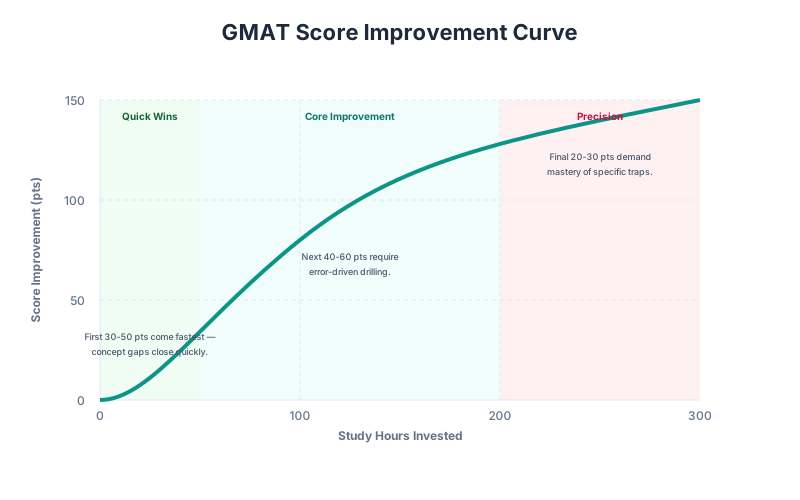
The GMAT is learnable, but score improvement follows a predictable curve. The first 50 points of improvement typically come quickly — often within the first 4–6 weeks — as you close obvious concept gaps. The next 50 points require targeted, error-driven work and take longer. The final 30+ points (approaching 700+) are the hardest, requiring mastery of the specific reasoning traps the exam uses repeatedly.
| Starting Score | Target Improvement | Typical Study Time | Key Focus |
|---|---|---|---|
| Below 555 | 100+ points | 200-300 hours | Foundational concepts + all three sections |
| 555-615 | 50-80 points | 150-200 hours | Error log + adaptive drilling + full-length mocks |
| 615-655 | 30-50 points | 100-150 hours | Advanced strategy + specific trap patterns |
| 655+ | 20-30 points | 80-120 hours | Precision under pressure + mental stamina |
The students who reach their target scores are rarely the most naturally gifted — they are the ones with the most consistent, structured approach. The GMAT is learnable by design: it tests a defined set of skills with a defined set of traps. Learning the system is the entire game. A diagnostic taken at the start of your preparation — OpenPrep's is free and calibrated to Focus Edition difficulty — gives you an honest baseline that separates the question of "is this test hard in general" from "how hard is this test for me, specifically, based on my current strengths."