ISB PGP MBA: GMAT Score, Deadlines, and Application Guide (2026)
ISB's Post Graduate Programme (PGP) is India's most competitive one-year MBA and consistently ranks among Asia's top business schools. It is also one of the most misunderstood — particularly when it comes to the GMAT score question that dominates every applicant's preparation strategy.
The most common question applicants ask is: what GMAT score do I need? The honest answer is more complicated than a number — and getting the nuance wrong can shape your entire application strategy badly.
This guide covers everything you need to know: what the class average actually means for your profile, what ISB genuinely evaluates, how the interview process works, and — if you are reading this in April 2026 — exactly how much time you have before Round 1 closes.
1. What GMAT Score Do You Actually Need for ISB?
ISB does not publish an official minimum GMAT cutoff. But that does not mean your score is irrelevant — it matters significantly. The class average for the GMAT Focus Edition sits at approximately 665–669. Here is what that number means in practice:
| Score Range | What It Means for Your Application |
|---|---|
| Below 640 | Significant red flag. Profile must be exceptional across every other dimension to receive a serious read. |
| 640–654 | Below average. Strong essays, high-impact career story, and an exceptional recommendation are essential. |
| 655–674 | Competitive zone — in and near the class average. A well-constructed application makes you a real contender. |
| 675–694 | Comfortably above average. Opens the door to merit scholarship consideration at the upper end. |
| 695+ | Strong academic signal. Still no guarantee — ISB has rejected 695 scorers with weak career narratives. |
The most important thing to understand about ISB's admissions model: a 695 with a flat, undifferentiated career story will lose to a 665 with a genuinely compelling one. The test score is a filter for academic readiness. Everything else is what actually determines whether you get a seat.
ISB accepts only test-centre based scores. The GMAT, GRE, and NMAT are all accepted, but only the in-person, test-centre versions. Online at-home versions of the GMAT and GRE are explicitly not valid for ISB applications.
2. Eligibility Requirements
- Completed bachelor's degree from any recognised university. There is no preferred field of study.
- At least 2 years of full-time work experience at the application deadline. The typical admitted candidate has 4–6 years, with clear career progression and demonstrated leadership potential.
- A valid test-centre GMAT, GRE, or NMAT score obtained within the past five years. Scores older than five years are not accepted, even if strong.
- English proficiency. For most applicants, your undergraduate degree in English is sufficient. No separate English language test is required unless your medium of instruction was not English.
3. Application Rounds and Deadlines
ISB runs three admission rounds each year. The structure below is based on historical patterns — always confirm exact dates on isb.edu before planning your timeline.
| Round | Approximate Deadline | Strategic Consideration |
|---|---|---|
| Round 1 | September | Highest admit rate. Full scholarship budget available. Apply here if at all possible. |
| Round 2 | November–December | Viable path, but scholarship funds are partially committed and the pool is larger. |
| Round 3 | January | Genuine last resort. Seats and scholarships are both significantly constrained. |
Round 1 is not just preferable — it is meaningfully different in outcome. The scholarship budget is fully intact, the applicant pool is smaller relative to available seats, and the admissions committee has maximum flexibility in constructing a diverse class. If you are targeting ISB, Round 1 is the target.
4. What ISB Actually Evaluates
ISB uses a holistic evaluation model across five dimensions:
- Test score (GMAT/GRE/NMAT). Used as a signal of academic readiness — specifically, your ability to handle ISB's rigorous quantitative MBA curriculum. It is a filter, not a ranking criterion.
- Work experience quality. The question is not how many years you have worked — it is what impact you had, how quickly you progressed, how much responsibility you carried, and whether your trajectory suggests genuine leadership potential.
- Essays. The admissions committee is looking for a candidate who can articulate a specific, credible post-MBA goal rooted in a clear-eyed understanding of their own career to date. Vague goals and generic language are the fastest paths to rejection.
- Letter of recommendation. ISB requires one recommendation letter from someone who has directly supervised or closely collaborated with you. Choose your recommender based on how specifically they can speak to your impact, not based on their seniority or title.
- Interview and Written Ability Test (WAT). If shortlisted, you will be invited for an interview day — see the next section for full detail.
5. The ISB Interview: What to Expect
The ISB interview day is a multi-part process that typically runs approximately two hours in total, conducted in-person at ISB's Hyderabad or Mohali campus.
Written Ability Test (WAT) — 20 minutes. You will be given two timed essay prompts and asked to respond in writing on your own device. The prompts are typically situational or opinion-based and test your ability to construct a coherent, well-reasoned argument under time pressure. Take a clear position and defend it with specific reasoning — this is not the place for hedging.
Panel Interview — 25 to 40 minutes. A panel of 2–3 members — typically drawn from ISB alumni, faculty, or senior staff — will probe your career history, leadership examples, post-MBA goals, and specific reasons for choosing ISB. Expect follow-up questions that test the depth and consistency of your answers. "Why ISB specifically, and not an IIM or a two-year programme?" is a question you must have a crisp, honest answer to. The panel can tell when ISB is someone's backup option.
The ISB interview is not designed to catch you out. The panel's goal is to understand whether you are genuinely ready for a demanding one-year programme, and whether ISB is the right fit for your specific career arc — not just a brand name on your shortlist.
6. ISB vs. Other Top Indian MBA Programmes
| Dimension | ISB PGP | IIM-A PGPX | IIM-C PGPEX | SP Jain GMBA |
|---|---|---|---|---|
| Programme length | 1 year | 1 year | 1 year | 1 year |
| Min. work experience | 2 years | 5 years | 5 years | 3 years |
| Accepted test | GMAT/GRE/NMAT | GMAT/GRE | GMAT/GRE | GMAT/GRE |
| Online score accepted | No | No | No | Yes |
| Typical score range | 655–690 | 680–720 | 670–710 | 640–680 |
| Class size | ~900 | ~65 | ~60 | ~60 |
ISB's significantly larger class size (roughly 900 students per year) means a more diverse and competitive applicant pool — but also more seats. If you have 2–4 years of experience, ISB is the strongest one-year programme you can target. If you have 5+ years and exceptional credentials, IIM-A PGPX or IIM-C PGPEX become legitimate alternatives to evaluate in parallel.
7. The Honest Prep Timeline (If You Are Targeting Round 1)
If you are reading this in April 2026, you have approximately five months before Round 1 closes. This is a tight but completely achievable timeline — if you start now.
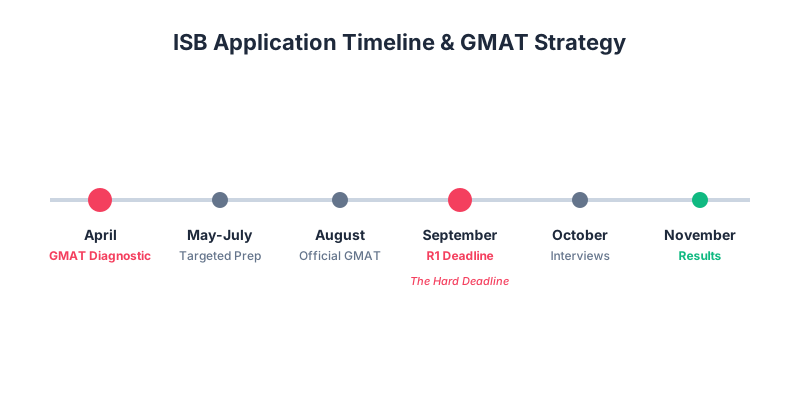
- April — Take your diagnostic today. A cold GMAT practice exam takes one afternoon and tells you exactly where your score stands. Use OpenPrep's diagnostic to map your accuracy across every sub-topic in the GMAT Focus Edition — this will tell you not just that 'Quant is weak,' but precisely which sub-topics are dragging your score.
- May through July — Intensive targeted preparation. Most candidates targeting a score of 660–680 need 150–250 hours of structured preparation. Prioritise your lowest-accuracy sub-topics first, and track your improvement weekly.
- August — Take the real exam. Aim to have your official GMAT score by late August at the latest. This gives you buffer time for a single retake if needed, and ensures your score is ready well before the Round 1 deadline.
- September — Essays and final submission. With your score confirmed, your full attention shifts to crafting your essays, finalising your recommendation letter, and assembling your application package.
Use OpenPrep's diagnostic to get a sub-topic accuracy breakdown across every area tested in the GMAT Focus Edition. This tells you not just that 'Quant is weak,' but precisely which sub-topics to prioritise in your 5-month window — so every hour of study between now and August is targeted.
The candidates who secure ISB Round 1 seats consistently share one characteristic: they started their diagnostic preparation in March or April, not in July. Starting in July still gives you a path to Round 2. But if Round 1 is your target — which it should be — April is when the clock starts.