What GMAT Scores Do Top MBA Programs Require? (2026)
Quick Takeaways
- No programme has a hard minimum — all use holistic review with GMAT as one factor
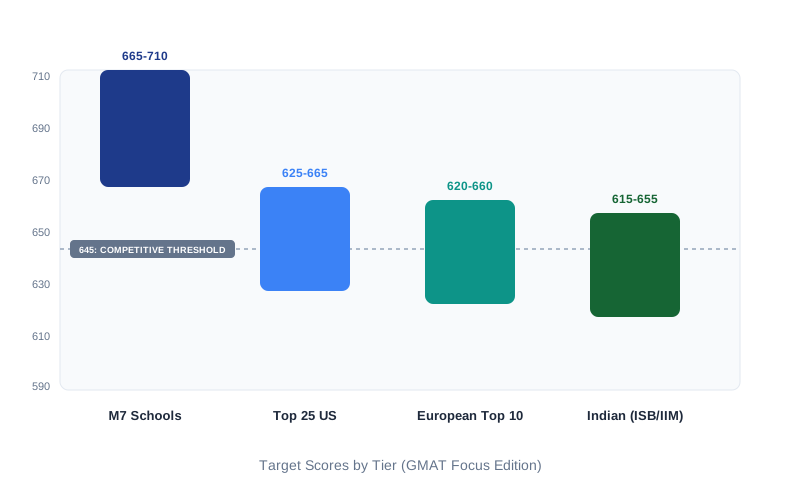
- M7 schools: Target 665+ on GMAT Focus Edition (equivalent to ~730+ on classic)
- Top 25 US: Target 645+ on Focus Edition (equivalent to ~700+ on classic)
- ISB Hyderabad: Target 700+ on classic / 665+ on Focus Edition
- IIMs (PGP): 680+ on classic / 640+ on Focus Edition for competitive applications
- Your GMAT is valid for 5 years — getting it done early gives you retake flexibility
Top MBA programmes do not publicise minimum GMAT scores — because they do not have hard minimums. What they publish is the class average and the middle 80% range: the scores of the 10th and 90th percentile of admitted students. Your goal is to score at or above the class average to be viewed as a competitive applicant.
This guide covers target scores for every major tier of MBA programme, with specific 2025/2026 class data and GMAT Focus Edition equivalents where available.
How MBA Programmes Use GMAT Scores
Admissions committees use GMAT scores for three specific purposes:
- Screening academic readiness: A score below the bottom 10th percentile of the class triggers additional scrutiny on your undergraduate record and work experience
- Contextualising academic records: A high GMAT offsets a lower GPA from a rigorous programme, or a GPA from a less well-known institution
- Competitiveness signalling: At M7 schools, a 665+ on the Focus Edition signals that you are a competitive candidate; below 640 requires a very strong application across all other dimensions
M7 Schools: The Most Competitive Tier
The Magnificent 7 (Harvard, Stanford, Wharton, Booth, Kellogg, MIT Sloan, Columbia) are the most selective MBA programmes in the world. Their score expectations reflect this.
| School | Average GMAT (Classic) | Middle 80% Range | Focus Edition Equivalent |
|---|---|---|---|
| Harvard Business School | 740 | 600-790 | ~690+ Focus |
| Stanford GSB | 738 | 630-790 | ~690+ Focus |
| Wharton (UPenn) | 728 | Not reported | ~680+ Focus |
| Booth (Chicago) | 730 | 630-790 | ~680+ Focus |
| Kellogg (Northwestern) | 727 | 640-760 | ~678+ Focus |
| MIT Sloan | 730 | Not reported | ~680+ Focus |
| Columbia Business School | 726 | 610-780 | ~677+ Focus |
At M7 schools, GMAT score data primarily reflects classic GMAT scores since most of their recent class data predates widespread Focus Edition adoption. The Focus Edition equivalents are approximations based on GMAC's concordance tables.
Top 25 US MBA Programs
Just outside the M7, scores become slightly more accessible — but the top programmes in this tier still expect competitive scores.
| School / Tier | Target GMAT (Classic) | Focus Edition Equivalent |
|---|---|---|
| Haas (UC Berkeley), Yale SOM, Dartmouth Tuck | 700-720 | 650-670 Focus |
| Duke Fuqua, Michigan Ross, UCLA Anderson | 690-710 | 640-660 Focus |
| NYU Stern, Cornell Johnson, Georgetown McDonough | 680-700 | 635-650 Focus |
| Texas McCombs, Emory Goizueta, Notre Dame Mendoza | 660-690 | 625-640 Focus |
Top European MBA Programs
European MBA programmes are increasingly accepting GMAT Focus Edition scores and use class averages that are broadly comparable to their US peers.
| School | Average GMAT (Classic) | Focus Equivalent | Notes |
|---|---|---|---|
| LBS (London Business School) | 701 | ~650 Focus | High weight on quantitative background |
| INSEAD | 703 | ~652 Focus | Both GMAT and GRE accepted |
| IMD (Switzerland) | 680 | ~635 Focus | Also accepts Executive Assessment |
| HEC Paris | 690 | ~643 Focus | Accepts GRE and GMAT |
| IE Business School (Spain) | 670 | ~630 Focus | Strong emphasis on international diversity |
Top Indian MBA Programs (IIM, ISB)
For Indian applicants targeting IIMs and ISB, competitive GMAT scores differ from the US market — and the competitive landscape is more defined.
| Programme | Competitive GMAT (Classic) | Focus Equivalent | Notes |
|---|---|---|---|
| ISB Hyderabad (PGP) | 700-720 | ~652-670 Focus | Work experience heavily weighted |
| IIM Ahmedabad (PGPX) | 710+ | ~660+ Focus | Executive programme; 5+ years experience required |
| IIM Bangalore (EPGP) | 700+ | ~652+ Focus | Executive programme |
| IIM Calcutta (PGPEX) | 690+ | ~643+ Focus | Executive programme |
| IIM Lucknow (iEDGE) | 680+ | ~635+ Focus | Executive programme |
| IIM Kozhikode (EPGM) | 680+ | ~635+ Focus | Executive programme |
| SP Jain (GMBA) | 650+ | ~610+ Focus | More accessible for earlier-career applicants |
GMAT Focus Edition Score Conversion
The GMAT Focus Edition uses a 205-805 scale (all scores end in 5), while the classic GMAT used a 200-800 scale. GMAC has published a concordance table showing score equivalencies. Key reference points:
| Classic GMAT | Focus Edition Equivalent | Approx. Percentile |
|---|---|---|
| 800 | 805 | 99th |
| 760 | 745 | 98th |
| 730 | 715 | 96th |
| 700 | 685 | 93rd |
| 680 | 665 | 89th |
| 660 | 645 | 83rd |
| 640 | 625 | 74th |
| 620 | 605 | 65th |
| 600 | 585 | 54th |
Strategy Based on Your Score Gap
Once you know your target score, the strategy depends on how far you are from it:
| Gap to Target | Recommended Strategy | Timeline |
|---|---|---|
| 0-20 points | 1-2 mock tests, targeted error log review, strategic guessing practice | 2-4 weeks |
| 20-50 points | Focused drilling on 2-3 weak sub-topics, 3-4 full mocks | 6-10 weeks |
| 50-100 points | Full structured plan covering all weak sections systematically | 10-16 weeks |
| 100+ points | Comprehensive plan starting with diagnostic, month-by-month phases | 4-6 months |
Know your gap before you build your plan. OpenPrep's free diagnostic places you on the 205–805 GMAT Focus Edition scale in 60 minutes and breaks down your performance by section and sub-topic — giving you the data you need to identify which row of the table above applies to you and which sub-topics are responsible for the gap.
When Your GMAT Score Alone Is Not Enough
A GMAT score above a programme's class average does not guarantee admission. Admissions committees look at the complete application, and a high GMAT with weak essays or average work experience is not automatically competitive.
Areas that complement a strong GMAT score:
- Work experience: The depth of leadership and impact in your professional history matters more than title at most M7 programmes
- Essays: The 'why MBA' and 'why this school' essays are the primary way to show fit, clarity of purpose, and self-awareness
- Recommendations: Specific, evidence-based recommendations from direct managers carry significant weight
- Interview performance: Many programmes conduct admissions interviews — strong interview candidates with solid (not exceptional) GMAT scores regularly receive offers