When to Take GMAT Practice Tests During Prep
Quick Takeaways
- Diagnostic: Take one immediately (don't study first) to set a baseline.
- Frequency: Every 3-4 weeks initially; weekly in the final month.
- Golden Rule: Analysis time > Testing time (review every question).
- Timing: Sync mock time with your actual exam appointment.
- Final Mock: 7-10 days before the exam (never closer).
Every GMAT journey is punctuated by a series of full-length practice tests. These are more than just dress rehearsals; they are critical diagnostic tools that guide your entire preparation. But when should you take them? Too early, and you risk discouragement. Too often, and you burn out. Too late, and you run out of time to fix your mistakes. Here’s a strategic timeline for when to deploy the most valuable assets in your GMAT arsenal: the six official practice exams.
Practice Test 1: The Diagnostic
When: Take your first practice test at the very beginning of your GMAT prep, before you've studied any concepts. Why: The purpose of a diagnostic test isn’t to get a great score; it's to establish an honest baseline. It gives you a clear, data-driven picture of your initial strengths and weaknesses, familiarizes you with the exam's format and pacing, and provides the raw data you need to build an intelligent, targeted study plan. Don't be discouraged by this initial score—it's just a starting point. OpenPrep's free diagnostic calibrates to the GMAT Focus Edition format and gives you a section-level breakdown in 60 minutes.
The Mid-Prep Check-In (Tests 2-3)
When: Schedule these tests periodically throughout the middle of your study plan, roughly after you've covered 60-70% of the core concepts. For a 3-month plan, this might be at the end of each month. For a 6-month plan, perhaps every 6-8 weeks. The key is to space them out. Why: These tests are course-correction tools. They tell you if your study plan is working. Are you improving in your weak areas? Have new problem spots emerged? Analyzing these mid-prep tests allows you to adjust your strategy, ensuring you're always focused on the highest-impact activities.
There are 6 official GMAT Focus practice exams available from GMAC (2 free, 4 paid). These are the gold standard and should be your priority, as they use the same scoring algorithm as the real test.
The Final Push (Tests 4-6)
When: In the last 4-5 weeks leading up to your exam, increase your frequency to one practice test every 5-7 days. Why: The focus now shifts to building stamina and perfecting your test-day strategy. You need to get your mind and body accustomed to the 2+ hour mental marathon. This is where you fine-tune your pacing, practice your break strategy, and build the confidence that comes from consistently performing under pressure.
The Final Dress Rehearsal
Take your very last practice test 7 to 10 days before your actual exam date. Do not take a mock test in the last few days before your GMAT. A surprisingly low score could crush your confidence, and you're better off using that time for light review and rest.
The Golden Rule: Analysis > Score
The number that pops up at the end of a practice test is the least important part. The real learning happens in the hours you spend analyzing your performance afterward. For every test, you should:
- Review Every Question: Don't just look at what you got wrong. Review the questions you got right to ensure your reasoning was sound and you didn't just get lucky.
- Categorize Your Errors: Were your mistakes due to a conceptual gap, a misread question, a simple calculation error, or poor time management? Understanding the why is crucial.
- Update Your Error Log: Your error log is your roadmap to a higher score. Feed it with data from every practice test to identify recurring patterns.
- Refine Your Study Plan: Use your analysis to adjust your focus for the upcoming week. If you struggled with pacing on the Verbal section, your next few study sessions should incorporate timed verbal drills.
The mock review protocol: how to review in the hours after
Most test-takers take a full-length mock, feel relieved it is over, look at the score, and move on. This wastes 90% of the learning value. A 4-hour mock should generate 3–5 hours of review — and the review protocol matters as much as the test itself.
- Review within 24 hours while memory is fresh. The longer you wait after a mock, the less you remember about your reasoning on each question. Review the same day or the next morning.
- Review every question — not just wrong answers. Questions you got right through guessing teach you where your instincts are unreliable. Questions you got wrong but nearly right reveal fixable gaps. Questions you got right confidently confirm which skills are solid.
- Categorise each error before reading the explanation. For every wrong answer, write down your theory of why you got it wrong — concept gap, misread, trap answer, time pressure — before you open the explanation. This forces active reasoning rather than passive reading.
- Identify the question type and error type separately. A Data Sufficiency error is not just "I got DS wrong." Did you fall for the C-Trap? Did you solve when you should have checked sufficiency? Did you forget to consider negative numbers? The more specific the diagnosis, the more targeted the fix.
- Flag the top 3–5 questions for re-attempt the next day. Set the most instructive wrong answers aside and attempt them cold 24 hours later, without looking at the explanation first. If you still get them wrong, the concept needs more practice. If you get them right, the issue was execution under time pressure, not knowledge.
- Update your error log and adjust your study plan. Every mock should change your study plan for the following 1–2 weeks. If your error log shows 60% of Verbal errors are "Out of Scope" traps on CR, your next two study sessions should focus specifically on that.
The time budget: For a 2h 15min mock, plan 3–4 hours of review. Allocate roughly 15 minutes per wrong answer and 5 minutes per right answer you felt uncertain about. A mock with 20 wrong answers and 5 uncertain rights = approximately 5 hours of review. This is not excessive — it is standard practice for students who improve 50+ points between their first and last mock.
Reading your score trajectory across mocks
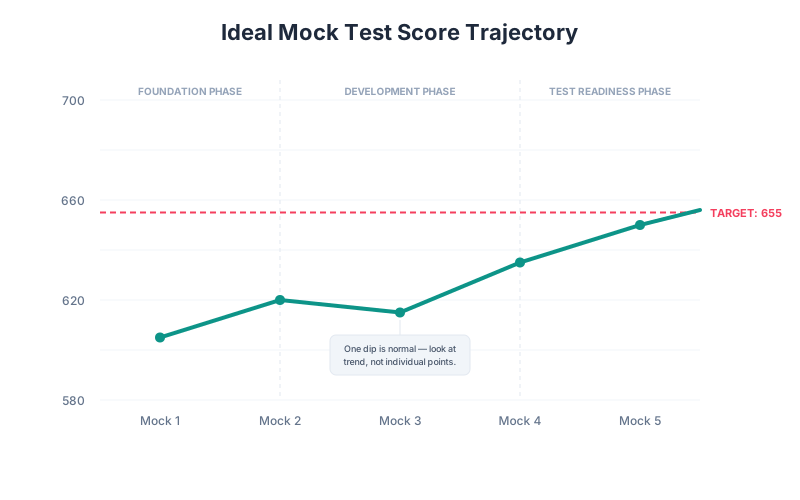
Your mock scores should not be interpreted in isolation — they are data points in a trajectory. A score that drops between Mock 2 and Mock 3 is not necessarily a sign of regression; it can reflect that you are attempting harder question banks, taking the test at a different time of day, or experiencing prep fatigue.
| Score Pattern | Likely Interpretation | Recommended Response |
|---|---|---|
| Steadily rising across all mocks | Preparation is working as intended | Maintain the plan, increase mock frequency in final month |
| Rising overall but with one dip | Normal variance — single data points are noisy | Identify what was different on the dip day (timing, fatigue, new question type) |
| Flat for 3+ mocks despite studying | Studying the wrong things, or not reviewing mocks deeply | Audit your error log for patterns; shift from new content to targeted drilling on specific sub-topics |
| Practice > Official score by 30+ points | Test-day anxiety or simulation quality issue | Increase test-day simulation fidelity: same time slot, strict conditions, no phone nearby |
| Official score matches or exceeds practice average | Strong readiness signal | If at or above target, avoid scheduling more full mocks — maintain with section drills only |